THE HAPPY WANDERER – SAN DIEGO

HILLS NEWSPAPERS: 05/22/2008

It was the final kerfuffle in a series of slapstick events that made up our weekend in San Diego. With just minutes till boarding, I found myself outside Southwest’s security zone with no identification.

I’d left my purse with my daughter to search for an airport bathroom with no queue. “You can’t go back that way,” said a stern-faced officer. “You’ll set off the alarm.” I had a hot flash as I paged my daughter to bring my I.D.

Several megastress moments later, my teen arrived with an attitude the size of Cleveland, lecturing me the entire way back to the gate as the flight door was ready to close. We made it on the plane — just barely.

Now, I know what you’re thinking. “What kind of mother doesn’t take her purse to the bathroom?” Try a mother who was too tired to think — after four days of shopping, fine dining and power bonding.

It was the kickoff of Mother’s Day weekend when we arrived in America’s City. That’s what San Diego was called when I lived there in 1983. Back then, the beach was my focus, but I wanted my 18-year-old to see something besides beer and bikinis. She’d see plenty of that in college. This weekend, we were meeting friends and staying in a more sophisticated spot — the city’s Gaslamp Quarter.

Once a notorious red light district, I could almost hear the bawdy laughter as I gazed at the 94 Victorians — gorgeous painted ladies nestled into just 16 square blocks. Our group joined a walking tour led by the Gaslamp Quarter Historical Foundation and heard tall tales from some of the period’s most colorful characters.

Appropriately, the Gaslamp today is still colorful, but in a more acceptable way. People spill into the streets from the dozens of noted restaurants and cafes, sending the visitor count soaring some 400 percent in the past 10 years.

The perfect home base for exploring the Gaslamp is the splendidly restored Ulysses S. Grant Hotel. Thirteen presidents have visited the Grant since its 1910 opening, but what’s impressive today is the length to which the owners, the Sycuan Band of the Kumeyaay Nation, have gone to honor the president they considered a friend.

They pumped $56 million into a renovation so grand the hotel just won Best Luxury Guestroom Design at the HotelWorld Global Hospitality & Design Awards.

From its signature Grant Grill to its 3,000-square-foot art gallery, every inch of the hotel befits a guest of honor and distinction. A guest like me.

My room was so lavish I didn’t want to leave. Even the headboard was a unique work of art, beckoning me into the luxurious bedding. But somewhere outside was a seafood dinner and a cheesecake with my name on it. I gathered my travel companions for dinner.

Oceanaire is one of the Gaslamp’s more celebrated eateries, with eclectic offerings like miso-glazed Oregon black cod and salt-and-vinegar fries. Our group was so big that half of us dined here and half took a cab to Oceanaire’s sister restaurant, Island Prime.

Both restaurants created a gluttonous feast that had us adjusting our waistbands well into the night. It also spurred us into action early the next morning.

“Hurry!” shouted our panicked friend, who’d taken charge of “shepherding” our group around town. We were sprinting, coffee cups in hand, to catch the Coronado ferry. Never mind that it was just a few blocks from our hotel — we were discombobulated and running late.

My daughter and another young gal had gone ahead to reserve bikes on the island, for our Mother’s Day ride to the Hotel Del Coronado. After sorting out who got the surrey and who got the beach cruisers, we had a leisurely ride (sans the surrey whose wide girth seemed to put it on a perpetual collision course with other vehicles.) And the Del didn’t disappoint. The grand old hotel with its broad, beachfront deck had succulent drinks and a great boomer band.

Perhaps the drinks were too succulent. Later that day, as our group toured the San Diego Museum of Modern Art, someone went out the emergency exit. A piercing alarm rang throughout the building and, while my friend didn’t admit to anything, she had that deer in the headlights look. We laughed about it over a delicious dinner at Prado, a restaurant known for its intoxicating fusion of flavors and eye-candy ambiance. Then we wrapped up the evening with a heady performance of “Beethoven as I Knew Him” at the nearby Old Globe Theatre.

Yes, it was a trip to remember — kerfuffles and all. In fact, I’m willing to say it was the mother of all Mother’s Day weekends.

Ginny Prior has a weekly syndicated travel radio show on Sports Byline USA, as well as travel features in print publications across the country. If you have a travel destination you’d like to share, drop a note to The Happy Wanderer at ginnyprior.com.

IF YOU GO:
The U.S. Grant Hotel: www.luxurycollection.com/usgrant
Gaslamp Quarter Historical Foundation Tours, leaving from the Westin Gaslamp Quarter: www.gaslampquarter.org
Oceanaire, Island Prime and Prado: www.cohnrestaurants.com
The Old Globe Theatre: www.theoldglobe.org
Coronado Island: www.coronadovisitorcenter.com
THE HAPPY WANDERER: OAKLAND

Oakland has plenty to offer travelers

YOU’RE PLANNING A getaway. You see yourself having incredible adventures, capped off with elegant dinners and electrifying nightlife. You’re thinking Costa Rica, Bora Bora — maybe New Zealand. But before you book globally, think locally, because this year, it’s hip to stay home.

Once the long-suffering step-sister of San Francisco, Oakland is finally grabbing the spotlight for chic restaurants and nightlife. Cool new venues like Levende East in Old Oakland are energizing parts of the city that used to shut down at dusk. In the 1870s, Old Oakland was the heart of town, with grand Victorian hotels built for travelers coming in on the Transcontinental Railroad. Today, it’s part of a renaissance that includes a vibrant Friday Farmers Market and a plethora of popular restaurants.

A few blocks away, in Uptown, uber-trendy clubs and eateries are drawing an eclectic mix of hipsters and after-work professionals. A perfect example is Café Van Kleef, where an animated crowd fills the bar almost nightly, spilling out onto the sidewalk by 6 p.m.

Rockridge continues to shine with celebrated spots like À Côté, where the long queues for dinner testify to its popularity. And in Montclair Village, chef/owner Henry Vortriede has his own style of comfort food (along with killer blackened brussel sprouts) at The Montclair Bistro.

But food isn’t the only thing that should draw you to Oakland. Consider a hike with a llama. On an outing offered by East Bay Regional Parks a few years ago, I led my buck-toothed friend “Freckles” along a dusty tree-lined trail in Roberts Regional Park. Contrary to what you may think, he was not the spitting image of an old boyfriend. He did, however, make some odd nasal noises.

While the llama trek may be an Andean-like adventure, the Oakland hills have parks that are reminiscent of other faraway places. Sibley Volcanic Regional Preserve reminds me of Ireland, with its velvet green crests and vast, sweeping views of the mountains and sea. In winter and spring, nearby Redwood Regional Park is so dense with vegetation, it resembles a rain forest. All this is just minutes from downtown Oakland, and as nature tends to be — it’s free.

So, too, is a stroll around the nation’s oldest wildlife refuge, Lake Merritt. And while the bird-watching is good, the people-watching is even better, with regular sightings of Oakland’s celebrity former Mayor Jerry Brown. Speaking of sights, along the shores of this great urban lake is a magical place that some say was the inspiration for Disneyland.

When Walt Disney came to Children’s Fairyland in 1954, he was so impressed, he hired the director away at double her salary. Fairy tales still come alive here and so do innovative ideas, like Fairyland’s summer overnights for families to pitch tents and see puppet shows under the stars.

Oakland is a mariner’s paradise and Lake Merritt is no exception. At the boathouse, you can rent sailboats and other nonmotorized vessels for a leisurely cruise. But for something really different, book a ride in an authentic Venetian gondola. With a handsome gondolier at the helm, you feel regal as you glide across the placid waters. All around you are the skyline and city, and the lights of Lake Merritt — like a romantic string of pearls.

Then there’s a nautical adventure that is more interactive; kayaking on the Oakland Estuary. California Canoe & Kayak has dozens of colorful kayaks in the water at Jack London Square. Take one out (instruction is available) and tour the waterfront that Jack London made famous in his adventure novels. You can even see a replica of his cabin in the square next to one of his favorite watering holes, Heinhold’s First & Last Chance Saloon. Like a scene from John Barleycorn, Heinhold’s is still serving ’em up — frothy and cold.

On my way to Yoshi’s World Class Jazz House near Jack London Square the other night, I watched the fog roll in — a little gift from our famous sister to the west. Its clammy fingers tried to pull me toward it — toward the city that always seemed to steal the spotlight. “Not this time,” I thought to myself. This time I’m opting for Oakland.

THE HAPPY WANDERER – AUSTIN

Austin is awesome Texas town
Contra Costa Times 4/11/2008

I’ve got four cowboy hats and a pair of Tony Lama boots that still have rodeo dirt on them. I guess that makes me a country girl — and it’s probably what draws me to Austin.

Not that you have to be country to like the eclectic capitol of Texas. In fact, locals call it the place where hippies meet techies and believe me, there are plenty of both.

But like most Texas towns, there’s a strong influence of cowboys and cattle — so much so that the University of Texas mascot is the Longhorns.

“Look how fast I can flash it,” bragged my college-bound daughter, who’d just been admitted to UT. She was practicing her “hook em’ horns” hand sign so she would be ready.

I can’t believe she actually used it; not once but dozens of times as we flashed “horns” to folks all over Austin. It was like a secret handshake that opened doors for us — even getting us into a couple of clubs on 6th Street, Austin’s famed music row. Not unlike Nashville, bar after bar hosts live music on 6th Street with everything from hard rock to blues. And while most places require you to be 21, there are a few 18 and over clubs on the strip that cater to students.

There’s also a four diamond hotel on 6th Street, which caters to the upper crust crowd with the fat wallet. The Driscoll is one of those places that you just stare at in envy, wishing you could take some of your kid’s college fund and spend the week there. Built by a cattle baron in 1886, the Grand Lady stands stately across a full city block, with her marble floors, gilded ceilings and warm wood and leather. Just having breakfast in the lobby café (The 1886 Café and Bakery is known for its fresh pastries and iron skillet meals) allows you to dream about what it would take to amass that kind of wealth.Then reality hits. “These are the free speech steps,” our chatty tour guide points out, as we follow the herd of new students on a tour of the University of Texas. “Y’all may be offended by what some folks say,” she smiles innocently, “but on these steps, they have a right to say it.” No one sounded off that day, at least not while we were there, but a man across campus was giving an outdoor lecture on Bible prophecies with a small but supportive crowd around him.

My daughter and I walked across the street and grabbed the Armadillo (the city’s free small bus and trolley system) to our hotel. Mass transit is everywhere in Austin, with the “Dillo” and a vast fleet of buses that get you around town for a buck or less.

And while Austin isn’t a big town, it’s big enough to have 11 La Quinta Inns. We stayed at the one near the Capitol, and it proved to be central to many of the city’s hot spots. I also liked the fact that La Quinta had a big heart in the aftermath of hurricanes Katrina and Rita, hosting hundreds of homeless families for weeks at a time. Their hospitality even extends to bats, after one of the winged creatures was found sleeping in the manager’s office. The little guy now has his own bat house on the property outside.

It’s not that far fetched, considering perhaps millions of bats live under the Congress Avenue Bridge nearby. It’s an amazing site to see them fly in formation at dusk, looking for bugs. Squadrons of pregnant bats shoot out of the underpinnings and darken the sky, creating an eerie, if not completely awesome sight. Austin even has a bat hot line between March and October, which you can call to get updates on projected bat fly times.

Bats aren’t the only colorful creatures that call Austin home. Politicians descend on Austin in odd years (no pun intended) and the state capitol is within walking distance of the university. It’s an architecturally stunning building and free tours are offered on a regular basis. Nearby is another free must-see attraction, The Lyndon Baines Johnson Presidential Library and Museum. It’s the only free presidential library and museum in the country, as stipulated by Johnson, himself, before he died.

That’s it in a pecan shell — a roundup of one of my favorite Texas towns. The buzz on Austin is true, as far as I can tell, and I’m just beginning to get to know her.

THE HAPPY WANDERER: VANCOUVER

Vancouver’s a beautiful, exciting destination

By Ginny Prior
Contra Costa Times 3/27/2008

I’d never heard of Da Vinci’s “Inquest” when I visited Vancouver. Now, I can’t get the Canadian TV program out of my mind. Shot for seven years in some of the city’s most colorful neighborhoods, the award-winning crime show was to Vancouver what “CSI” is to Miami. And the reruns remind me this city deserves more than a “port of call” stop on a cruise to somewhere else.

“The weather is super, eh?” The East Indian cabbie sounded surprisingly Canadian as he made small talk en route from the airport. We were motoring through Vancouver in a Prius, the car of choice for cab drivers in this super progressive seaport city.

Quietly, almost stealthily, we passed through the busy streets of a densely populated downtown, pulling up to the Pan Pacific Hotel and the adjacent cruise ship terminal. I barely recognized this spot as Canada Place from my two trips to the 1986 World’s Fair. That event, as much as anything, had put Vancouver on the map.

A blast of the horn and the gleaming Holland America cruise ship was calling her passengers to board. She’d been docked here patiently as her charges toured the town. I watched them juggle their purses and packages from my hotel suite window, which wrapped halfway around the room and offered views of the city on one side and the harbor on the other. High above the plaza, I was, as my friends called it, “living large.”

It was easy to get caught up in the energy of a city like this. More than 900,000 passengers come through Vancouver each year; many on their way north to Alaska. They find the climate here appealing and the food and shopping exceptional.

I was eager to experience both. Setting out on foot, I headed toward the city’s oldest district, Gastown. With its handsome brick buildings and cobbled streets, Gastown was enjoying a renaissance, of sorts, although still a bit rough around the edges. More than once I passed people who looked like they were right out of Da Vinci’s “Inquest.” But Gastown was hip, too, and funky. My favorite sidewalk attraction was the steam-powered clock that whistled and whirred on the quarter hour.

I built up an appetite walking through Gastown and that was a good thing. My tour group was meeting at Aqua Riva, one of Vancouver’s premier restaurants. Built on the waterfront next to our hotel, Aqua Riva had amazing harbor views and a menu to match. Course after course was exceptional, paired with equally fine British Columbia wines. We topped off the evening with a Canadian kiss — a glass of British Columbia’s celebrated ice wine.

Day two had me following a friend’s advice, with a bike ride through Stanley Park. The hour-long ride offered stunning views of the North Shore mountains and Lions Gate Bridge, as well as a roll through an urban forest and past fragrant rose gardens. The ride was pure pleasure with plenty of places to stop and picnic or rest.

As predictable as a sunset, I had worked up an appetite again and went looking for substance at Vancouver’s popular Granville Island Public Market. The place where chefs shop for fresh produce and seafood, I quickly realized the artisan qualities of their breads, cheeses and other foods. Once a sad and forgotten industrial site, Granville Island is the pulse of the city’s celebrated restaurant scene today. My only complaint was my luggage wouldn’t hold all the specialty foods I was tempted to bring home.

It would take more space than I’ve got here to do this city justice. A guide book would barely scratch the surface. But a list of must-see locations has to include Yaletown (a hipster hangout brimming with boutique shops and possibly the world’s best facial (my skin glowed for weeks after my treatment at a spa called Spaethos); English Bay, where the beaches and sunsets attract locals and tourists alike; and a drive along BC’s famed Sea-to-Sky Highway to Whistler. It’s considered one of the most photogenic highways in the country and Whistler, of course, is a host of the 2010 Winter Olympics.

That’s Vancouver in a nutshell — one of the most exciting cities in the Pacific Northwest. Pardon me, now, while I retreat to the television room. There’s a Canadian crime show I want to catch.

THE HAPPY WANDERER: SIERRA SKIING

Celebrating Spring – in the Snow!

By Ginny Prior

Contra Costa Times


The music pulsates. Bikini-clad women sun themselves on the sprawling decks. A guy in a moose hat chugs a beer as his buddy takes a mongo bite of his barbecued burger. It’s mid-March, and the party scene sizzles at Sierra ski resorts, where they ring in spring with their own mix of sunshine, snow and silliness.

With plenty of white stuff to last through April, folks get a little giddy this time of year. The sun warms, the snow softens, and moods seem to lighten as skiers don silly sunglasses, crazy hats and everything from swim wear to lederhosen. The people-watching is primo.

So, too, are the myriad events that resorts come up with to celebrate spring. One of my favorites is the annual Mount Rose Dummy Downhill, a race you can watch from the lodge where dummies fly down the mountain at break-neck speeds. I’m not talking humans here, but stuffed dolls and mannequins. Anything without a pulse.

At Heavenly, it’s just the opposite. Real people with really loud screams are streaking through the air on the longest zip line in the continental United States, called the Heavenly Flyer. Think 80 seconds of stomach-in-your-throat fun, dropping the distance of the Space Needle at 50 mph. It’s a wild way to see one of the world’s most scenic views — if you can keep your eyes open.

Or not.

A decidedly more civilized way to ring in spring is with wine glass in hand — toasting the sunset at Tahoe’s Diamond Peak Resort. On Saturday afternoons through the end of the ski season, Last Tracks lets skiers ride the lift to the mid-mountain Snowflake Lodge, where featured wines and cheese are served in a stunning mountain setting. The best part is the trip down, on freshly groomed “corduroy” that the snow plows have been making while you’ve been enjoying your nibbles and sips.

One of the premier party resorts since its recent expansion is Northstar at Tahoe. With a new European-style village at its base, Northstar has fire pits and drink stations set up all around the center’s crown jewel — the ice rink. Comfy sofas and chairs invite Après skiers to sit and soak up the scene on a sunny spring day or a cool, starry night.

Easter is a colorful day at Sierra ski areas, with traditional egg hunts, mountain-top church services and other special events. The bunny makes his rounds, too, popping in at every resort before soaking his rabbit’s feet in Epsom salts at sunset. One of the best egg hunts is at Squaw Valley, where 1,000 eggs are hidden on and around the mountain. Parents who don’t want to participate can soak in the High Camp Swimming Lagoon & Spa while their kids round up the oblong treasures.

Spring is one of the best times for another kind of skiing — cross country. As the snow glistens like diamonds in the filtered light, wildflowers poke shyly through patches of white in the sun-splashed meadows. The acres of pristine forest and track seem to go on forever at Royal Gorge, indeed the largest cross country ski resort in North America. On a recent day here, (just 21/2 hours east on Interstate 80) a friend and I worked up such an appetite that we found ourselves stopping at the Reindeer Bar in the Ice Lakes Lodge. Sound romantic? I fell in love almost immediately. With the food.

The tri-tip was tender and juicy and served on a toasted baguette with fried onions, melted provolone and spicy horseradish sauce. The French onion soup was a savory blend of sweet onions, port wine and imported Gruyere, served with freshly baked sourdough bread. The Pinot Noir was a perfect compliment and warmed my tummy for the trip back to the main lodge.

If you thought ski resorts served only French fries and pub food, you haven’t been to Royal Gorge. Much like the solitude of their cross country trails, a well-prepared meal has a lot of appeal for the older, more sophisticated skier. It’s another reason why more and more boomers are switching to cross country skiing. And while you probably won’t see moose hats and bikini tops, my bet is you’ll have just as much fun.

THE HAPPY WANDERER: LONG BEACH

Long Beach has plenty to offer

By Ginny Prior
Contra Costa Times 2/29/2008

FIRST IMPRESSIONS can be deceiving. Take Long Beach, for instance. Twenty years ago I came here with my parents and husband. We toured the Queen Mary. We got lost trying to find our hotel. We left the next day thinking, “Is that all there is?”

Well, Long Beach has grown, and so has my enthusiasm for this hip beach spot. Credit the “Grand Lady” with much of the money that has been pumped into Long Beach. Billions of tourism dollars have rebuilt the harbor, the canals and an exciting and vibrant downtown with world class museums, shopping, restaurants and more.

Strolling the waterfront, recently, I felt a sense of de ja vu. I’d seen those sexy palm trees swaying along the shoreline before. Turns out, the most popular show on television, “CSI Miami,” shoots much of its footage here. It’s an added attraction if you like Horatio Caine as much as I do.

But spending the day looking for David Caruso is a waste in this fun town. There are too many other things to do, like take a Segway tour of the waterfront in a pod of other scooter people. If you take yourself seriously, this isn’t the activity for you — as, quite frankly, you’ll look ridiculous on one of these futuristic machines. But boy are they fun, and a great way to see the city.

Or you can bike along the 5.5 miles of waterfront walkways. Long Beach is so progressive with its transportation; it boasts the first U-S Bikestation, with free indoor parking and low cost bike repairs.

Getting around by boat is just as easy. AquaBus water taxis take up to 49 passengers in their bright red vessels with stops at the aquarium, Queen Mary, Shoreline Village, Catalina Landing and three other “ports of call.” The fare is a bargain at one buck. For $3, the larger AquaLink catamaran will ferry up to 75 folks along Long Beach Harbor and points nearby.

But nothing beats a romantic ride in a Venetian Style gondola. A little wine, a little cheese and some sourdough bread and your mate will look better than David Caruso — I guarantee it. The Gondola Getaway takes lovers along the scenic canals of Napals Island in Belmont Shores. A singing gondolier pilots the boat and points out items of interest along the way. The cruises run daily from 11 a.m. to 11 p.m., with sunset cruises being the most popular, of course.

The mother of all vessels, the Queen Mary, has a hip new image as well. On any given day, there could be dozens of parties and weddings on the elegant ship. Ghosts streak across the decks and balconies, popping in and out of places like the ship’s massive pool, which is bone dry but still sports mysterious wet footprints from time to time. As unnerving as this may be, it’s not hard to see the attraction. Even a ghost can appreciate the fascinating tours, the night life and the superb cuisine at the Queen Mary’s premier restaurant, Sir Winston’s. There’ no other venue quite like it.

Speaking of ships, The Carnival Cruise line opened a terminal in Long Beach in 2003. It operates next to the Queen Mary, with destinations in Mexico and along the Panama Canal. Another popular cruise destination, Catalina Island, is just an hour by boat from Long Beach. There is so much to do on Catalina, the Happy Wanderer will feature it in a separate article.

I would be remiss if I didn’t mention a few other highlights of my trip. The Aquarium of the Pacific is a fascinating look at more than 12,500 creatures that live in the sea. But what really tickled me was their bird aviary outside. With a handful of food, I had more Lorakeets landing on me than Tippi Hedren in “The Birds.”

The Museum of Latin American Art was a favorite stop, with its fascinating self-guided tour (accessed by cell phone) and an eclectic gift shop, where I purchased a shiny blue purse made of gum wrappers.

And a hidden gem — The Vintage Tea Leaf at 969 E. Broadway — where we donned vintage hats and sipped glorious tea from bone china cups. An elegant plate of petit fours complemented our choice of nectar, an exotic tea which blossomed into a flower as it steeped in a clear glass pot. It was quintessential Long Beach; a city that knows how to celebrate.

If you go: Jet Blue and several other airlines fly into the passenger-friendly Long Beach Airport.

Heads up: The Toyota Grand Prix of Long Beach runs April 18-20 along 1.97 miles of Shoreline Drive. Make reservations early if you want to attend this popular event.

Web sites to check before you visit:

Visitlongbeach.com

Aquariumofpacific.org

Gondo.net

molaa.org

segwaylb.com

queenmary.com

vintagetealeaf.com

THE HAPPY WANDERER: LODI

It’s Good Being Stuck in Lodi

Contra Costa Times


By Ginny Prior

MENTION LODI and baby boomers picture a town so dull, the band Credence Clearwater Revival once wrote a song about it. But these days, being “Stuck in Lodi, again” is a good thing. Less than 90 minutes from Alameda, Lodi is a world apart from Stockton and other Central Valley neighbors.

“There’s a spike in home prices when you get to Lodi,” one Realtor told me, and the reason is plain to see. The town is as neat as a pin — with an inviting downtown shopping district and its own wine country.

Head north on I-5, past the farms and the truck stops and the miles of fast food outlets, and just north of Stockton you’ll see the landscape change. Turn east onto Highway 12, and vineyards and fruit stands now dot the countryside, with freshly painted homes tucked neatly between acres of farmland. Just 7 miles away — Lodi starts to draw you in.

Built along the Mokulemne River, Lodi was founded by German settlers who took pride in their farms, towns and churches. It remains a shady respite for sun-baked delta travelers today. More than 50 wineries make their home here, including Woodbridge and Michael David — known for its popular “7 Deadly Zins.” But your first stop should be the Lodi Wine and Visitor’s Center, where you can taste local wines, learn about the region and pick up a wine trail map. Unlike the celebrated wine regions of Napa, Sonoma and even Livermore, the wine trail here is devoid of traffic and crowds. It’s the quintessential country road, with acres of old Zinfandel vines and enormous Valley Oaks.

Back in town, the heart of Lodi pulsates with popular eateries and a bustling new multiplex theater. Farmers bring organic vegetables to the open air market and they’re snapped up in minutes.

But the epicenter of the town’s gourmet restaurant scene is the Wine and Roses Hotel. It’s a beautiful country estate with acres of flowers and manicured lawns and plush, Victorian rooms. It’s easy to see why weddings are so popular here, but it’s also the locals’ favorite. The restaurant is exceptional, with much of the food grown organically in the fertile fields nearby. Even the duck is raised locally, and the flavor rivals anything you’ll find in the Bay Area’s top restaurants. What’s different is the way you feel when you’re here — like an old friend. Owner Russ Munson sees to this, stopping by each table to greet his guests.

The night I was there, I was even invited to sing at the piano — with the wonderful Rudy Tenio, who’d been playing music all day in the cool delta breeze. Hours after his “gig” had ended, he obviously felt the way I did — that this place was too special to leave. Being in Lodi was a good thing. I can’t wait to be “stuck” there, again.

For more information on Lodi http://www.visitlodi.com , the Lodi Wine and Visitor’s Center at http://www.lodiwine.com, The Lodi Conference & Visitors Bureau at (209) 365-1193, or Wine & Roses Hotel at (209)334-6988. Lodi is serviced by both Greyhound and Amtrak and the stations are within walking distance of downtown.

Ginny Prior has a weekly syndicated travel radio show on Sports Byline USA, as well as travel features in print publications across the country. If you have a travel destination you’d like to share, drop a note to The Happy Wanderer at ginnyprior.com.

THE HAPPY WANDERER: LIVERMORE WINE COUNTRY

Wine country love affair grows
By Ginny Prior
Contra Costa Times

It was a balmy spring night when I first fell in love. Maybe “crush” was more like it, considering the object of my affection. I raised my glass and toasted the sunset — the wine blush fresh on my cheeks as I celebrated my affair — with the lush rolling hills of the Livermore Valley Wine Country.

While most people think of Napa and Sonoma as “the wine country,” Livermore is California’s oldest wine region. In fact, it was a Livermore Valley wine that won the first Gold Medal for California at the Paris Exposition in 1889. Today, the combination of exceptional soil and an abundance of chemists from nearby Lawrence Livermore Laboratory have spawned a number of exceptional boutique wineries.

Winding your way east along Interstate 580, take Vasco Road south toward the Wente Vineyards. This is the valley’s oldest continuously operated family-owned winery. The tasting room has a picturesque picnic spot at 5565 Tesla Road, where you can sample wines daily from 11 a.m. to 4:30 p.m. Continue southwest on the vineyard laced road and you end up at a splendid estate tucked against velvety green hills. This is the Wente Restaurant and Visitors Center. This is where true love begins. Settle into the sumptuous dining room and sip one of hundreds of wines from California and beyond. Get lost in the fragrance of the flowering trees and the aroma of fresh herbs and sauces coming from the kitchen. The views of the golf course and beautifully manicured grounds are as appealing to the eye as the food is to the palate. Top dinner off with a summer concert in the vineyard (June through September) and you’ll see why the Zagat Survey lists Wente as one of America’s top restaurants.Other wineries bring their own special charm to the Livermore Valley. Nestled in a grove of ancient pepper trees, is a little giant called Retzlaff. Not only are these boutique wines extraordinary, they are all organic — made by hand from grapes grown on site with no fertilizers, herbicides or pesticides. How do owners Bob and Gloria Retzlaff do it? Naturally. They put up hawk houses and hawks moved in to prey on the Starlings. They build owl roosts and the owls take up residence, feasting on gophers and mice. It works beautifully, as Retzlaff has some of the tastiest wines and most charming picnic grounds in the Livermore Valley. Open to the public, they host annual events for Mother’s and Father’s Day, the Fourth of July, and Labor Day weekend when they have their popular Harvest Wine Celebration. On summer weekends in July and early August, they feature Shakespeare under the stars. Retzlaff Vineyards is at 1356 S. Livermore Ave. They are open for tasting from noon to 2 p.m. Tuesdays through Fridays and from noon to 4:30 p.m. on weekends.

No trip to this region would be complete without visiting Concannon — a vineyard that goes back to Livermore’s early wine making days. While Robert Livermore planted the first commercial vines in the 1840s, pioneer winemakers C.H. Wente, Charles Wetmore and James Concannon founded the first wineries in the early 1880s. They were the first to bottle varietally labeled Chardonnay, Sauvignon Blanc and Petite Sirah. Concannon is still going strong today, producing award-winning wines at its historic site at 4590 Tesla Road. They offer tasting daily from 11 a.m. to 4:30 p.m.

The Livermore Valley Wine Country has over 3,800 acres of vineyards, with 43 wineries and a number of top notch golf courses. Laced between acres of new high-end homes, you may be tempted to relocate here. As the sign says – “If you lived here, you’d be home now”. Home amongst the vineyards and some of California’s oldest and most celebrated wines. For more information, log onto http://www.livermorewine.com or contact the Tri-Valley Convention and Visitors Bureau at 1-888-874-9253.

Ginny Prior has a weekly syndicated travel radio show on Sports Byline USA, as well as travel features in print publications across the country. If you have a travel destination you’d like to share, drop a note to The Happy Wanderer at ginnyprior.com.

Burning Down the House

OAKLAND MAGAZINE – NOVEMBER 20007

la-tazaWhen Daniel Brajkovich opened La Taza de Café in Montclair in 2004 , I knew we couldn’t keep him. His savory tapas and hot Latin Jazz were too big to contain in a small neighborhood restaurant. He needed a whole house.
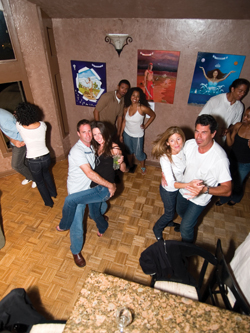
Today, he’s bringing the house down with a Cuban café and club that’s so popular it’s often packed to the rafters. Of course, there’s the ever-changing weekly menu, from small plates with various combinations of grilled chops, plantains and spicy sauces to such platos grandes as garlic-studded slow-roasted pork and snapper almandine. Then there’s the dancing. Take a Saturday night this past summer, for example, when a room full of patrons paid $8 each to learn how to salsa. The instructors were the sexy dance duo of Garry Johnson (longtime dance teacher at Allegro Ballroom in Emeryville) and his partner, Viola Gonzales. As the lesson progressed, the warm yellow house at 3909 Grand Ave. (formerly the site of Autumn Moon restaurant) started to come alive. Women in sleek, sexy outfits and guys in cool cotton cabana shirts were pouring into the bar, the back room, the outside patio and two rooms upstairs.
The champagne mojitos started to flow and bodies pressed seductively against one another as the primal beat pumped through the halls. I could sense that something was about to explode—like spontaneous combustion from too much heat. And then it began; couples twirling in tandem to the intoxicating rhythm, as if they were dancing under a star-studded Havana sky.
It’s human nature to want what you cannot have. Cuba is off limits to most Americans, yet we have an insatiable urge to taste—to experience—if only for one passion-filled night. La Taza de Café answers the call.
La Taza de Café, 3909 Grand Ave., (510) 658-2373, is open Tue.–Sun. for tapas, dinner and dancing, and serves brunch 10 p.m.–2 p.m. Sun. For a schedule of dance lessons and entertainment see www.latazadecafe.com.

DAKOTA DEUTSCHLAND

AAA Living – North Dakota

September/October 2007

Harvey Schilling taps a German tune on the accordian

Harvey Schilling taps a German tune on the accordian

German Russians found their place in North Dakota more than a century ago. Today, their vintage lifestyle draws travelers to the south-central part of the state.

In a list of the world’s gourmet foods, sauerkraut never seems to make the cut. But don’t tell that to the folks who make their home in what’s known as North Dakota’s “Great Sauerkraut Triangle.” Although called a triangle, this irregular polygon-shaped region (spanning roughly from Edgedale west to Linton, south to Zeeland and north to Napoleon) dishes out some of the best German food, architecture and culture this side of Munich. In the words of North Dakota’s most famous German Russian, 1950s band leader Lawrence Welk, the region is “wunnerful, wunnerful!”

My own heritage traces back to this area settled by German immigrants from Russia who fled the oppressive tsarist tyranny from about 1880 to 1920. I was born in Eureka, South Dakota, which, before cartographers drew state lines, was part of the German-Russian territory. As I travel through the towns of southern North Dakota, I recall a high school cheer my uncle taught me. “Wieners und wieners und sauerkraut,” he’d begin with his thick German accent, “we are from Hosmer, five miles out!” I bet we weren’t the only German descendants who shouted the rhyme.

Standing on a knoll above Welk’s childhood home in Strasburg, I watch the prairie grass sway as if orchestrated by the late conductor’s baton. A tiny lake sparkles in the distance behind a cluster of old barns, a granary and the simple sod house where Welk lived until his 21st birthday.

I realize that the charm of these towns lies in how they’ve held dearly to their traditions. The communities’ visible commitment draws visitors from near and far to reconnect with their roots—or just get a good bowl of borscht (hearty cabbage soup) or some cheese buttons (noodle dough filled with seasoned cheese and onions). In some places, such as the Edgeley Coffee Shop in Edgeley where kuchen (fruit and custard pastry) and a German burger (crowned with white cheese and sauerkraut) is served, barking, consonant-riddled German echoes in the air. The cook, Jean Neff, offers a friendly gutentag (good day) to me, before turning back to her conversation in German with some of the older customers.

Food from the Old Country is just part of the sauerkraut triangle heritage package. “Almost every one of those counties has a great museum,” says Bismarck history buff Michael Rempfer. The McIntosh County Heritage Center in Ashley is a perfect example, with an early rural Lutheran Church, a sod house, a one-room school and other historical buildings on site. These museums serve as living memories of the days when hardworking immigrants plowed the parched, rocky earth to plant crops and build communities. “You can still hear the accents of the people in most of those places,” says Rempfer. “The rural lifestyle—in some places you can still find the old buildings built with mud bricks and stuff like that.”

Mud bricks are really just a fancy name for dirt and manure. Historian Michael Miller with the Germans from Russia Heritage Collection says the state’s treeless terrain, much like the steppes of Russia from which the immigrants came, forced the settlers to use building materials other than wood. A well-preserved, original sod home still stands eight miles east of Strasburg.

More than any other buildings, churches received remarkable attention to detail. They were elaborate, using brick, stone and stained glass as evidenced by the St. Peter & Paul Catholic Church in Strasburg—proof of the importance of religion to these pioneers.

Just outside Hague, a Catholic cemetery contains as many as 70 ornate, black eizenkreuzen (iron crosses). Each cross tells its own story. Forged by immigrant blacksmiths in Hague between 1877 and 1941 (using skills they’d learned from their ancestors on the steppes of the Volga and the Black Sea regions of Russia), these prairie monuments can be quite intricate, with elaborate symbols depicting everything from angels to snakes. As I walk down the rows, I can almost imagine the sweat and sadness that went into each one of these crosses, timeless reminders of the hardships these pioneer families endured.

The crosses and other tangible history add to the beauty of this region. They’re a part of North Dakota’s heritage that should be treasured and shared for generations to come. Even if you don’t like sauerkraut.

Let AAA help put you up for the night. Visit AAA.com for more information.

Germans from Russia Fall Fun

New Leipzig: The annual Octoberfest, Sept. 21–23, features German music and cloggers, traditional Germans from Russia food demonstrations, and booths and cultural demonstrations, such as loom weaving and plow sharpening. Contact: Mark Stetler at 701-584-2278.

Wishek: The 82nd annual Sauerkraut Day happens October 10 at the Civic Center. Eat wieners and sauerkraut, while enjoying German music at this free community luncheon. Contact Stan Deile at 701-452-2351.

Strasburg: Stroll the grounds of Lawrence Welk’s birthplace in Strasburg, 701-336-7519.

Napoleon: Logan County Historical Society preserves an historic schoolhouse, a house built in 1907, Logan County church, a blacksmith shop and harness shop; 701-754-2511.

Ashley: Browse more Germans from Russia pioneer history at McIntosh County Heritage Center circa 1900. Historic buildings include a church, sod house and school house; 701-288-3388.

Hague: Carry a handkerchief as you walk among the handcrafted iron crosses at St. Mary’s Catholic Church and Iron Cross Cemetery, 701-336-7119. The effort manifested in these labors of love might move you to tears.

South of the Border

In addition to North Dakota, South Dakota is home to many of the German Russian settlements of the late 1800s and early 1900s, including one that largely has been preserved. Eureka, hailed as the “Wheat Capitol of the World” from 1887 to 1902, was a bustling center of commerce at the end of the rail line. Today, there is still plenty to see. The Pioneer Museum holds a fascinating collection of German-Russian artifacts, farm implements, period clothing and more. The City CafÈ is a popular place for German meals and two businesses bake sweet German pastries, The Eureka Bakery and The Kuchen Factory. An oddity, perhaps, is the City Cemetery, where native son and USA Today founder Al Neuharth has his headstone. Neuharth isn’t dead yet, but like most Germans from Russia, he plans ahead.

Ginny Prior makes annual trips to the Sauerkraut Triangle, eating everything except prune kuchen.

Photography by Ron Rouse.