The Wild San Mateo Coast

Alameda Magazine

November 2005

I have a friend who loves to travel. And she’s blessed with an abundance of wealth, making the entire world her playground. But often she’ll pack a small bag and head south, not for Cabo or the Caribbean, but to the San Mateo coast.

Her love affair with the ocean begins along the winding roads that traverse the Santa Cruz Mountains. An imposing barrier between east and west, this rugged spine has been a formidable foe to developers who’ve seen the coast as too foggy, too windy and too inaccessible. “It’s like entering a bygone era,” according to locals who fight passionately to preserve San Mateo County’s farms and ranches. Tiny towns look as though they’re frozen in time, not minutes from a major metropolitan area. But read on and you’ll find a land of surprises, from ghosts to gourmet food and spiritual retreats to world-class resorts. And with this trip, there’s no jet lag.

California Highway 92 cuts a swath through the populated peninsula and turns rural as you head west toward the Crystal Springs Reservoir. Winding through nurseries and roadside antiques shops, Obester Winery stands almost at the junction with California Highway 1. Obester is known for the eight or nine days each year when the winery will fill your clean, empty bottles with private reserve for under $5. But the winery also has picnics, tastings and even a bocce ball court.

What Obester doesn’t have is a ghost. That claim to fame lies solely with the Moss Beach Distillery, a few miles north. Perched on a cliff above the crashing surf, this place was a hot spot during Prohibition and remains so today. Perhaps while you’re dining, you’ll feel a chill or a tap or hear the wail of a woeful spirit. It could be the Blue Lady, whose unsettling story has been told to countless travelers and featured on television’s Unsolved Mysteries.

From spirits to serenity, you head down the coast past surfers and specialty shops and into a world of stunning opulence. The five-diamond Ritz-Carlton stands high above the bluffs of Half Moon Bay, like a grand Scottish lady with the wind and the sea at her beck and call. As the bagpipes call the golfers in at sunset, the moist, salty air is a tonic for the skin and the soul. Staying at the Ritz-Carlton is a feast of all that’s abundant here. Pumpkins are used for the spa’s signature body scrub and hydrating pumpkin body peels. Area farmers bring in local beets, herbs and artichokes for the resort’s award-winning restaurant, Navio. Fresh goat cheese comes from nearby Harley Farms, where it’s handmade with care and a garnish of edible flowers. Life at the Ritz is a celebration that shouldn’t be missed. Just minutes after arrival you feel a lifetime of stress simply melt away.

The San Mateo Coast has a way of getting inside you – the miles of undisturbed beaches, the ancient redwood forests and the patchwork of green that grows out of the sand-colored cliffs. You can have virtually any kind of experience here, from staying at a 19th century lighthouse (Point Montara Light Station) to sleeping in a luxury tent cabin (Costanoa). You can stroll through hamlets like Pescadero, with more than a dozen historic buildings including the town watering hole, Duarte’s Tavern.

Or see the pinniped version of a loud, belching couch potato at the Ano Nuevo State Reserve. Just a short drive from Pescadero and a mile or so hike down a coastal trail is the largest elephant seal breeding colony in the world. December through March is mating season, but at least some of the herd hangs around in the off months.

In stark contrast to the blubber and barking at Ano Nuevo, a peaceful drive through the coastal redwoods is as close as Skyline Boulevard. Winding its way past cabins and conifers, this is the quintessential highway for a road trip. Pull in at the famous and funky Alice’s Restaurant (not the one that Arlo Guthrie sang about) and you’ll see everyone from motorcyclists to movie stars. Stay at the nearby Stillheart Retreat Center in Woodside and you’ll find yourself in such a deep state of quiet that you’ll notice eve the smallest things in nature. Then have dinner at the popular Village Pub, where the menu includes the most eclectic offerings, like wild nettle soup and perfectly prepared sweetbreads.

Feeling déjà vu? It’s not surprising with a visit to nearby Filoli Gardens. You’ve probably seen the long country road to the Georgian brick mansion before. The opening scenes for Dynasty were filmed at this gorgeous garden estate, as well as scenes from a number of popular movies.

From film directors to tourists, folks are finding what my friend has found, a part of the Bay Area that rarely gets noticed. But please, don’t all come at once. The charm of this region is its quiet, untamed spirit: so close to the city, yet so far away.
The Land of the Midnight Sun

Doing Alaska in Four Days

Oakland Magazine, July/August 2005

alaska_bikingThey call it the last frontier – a land so wild, less than one percent has been altered by man. Boarding the plane at Oakland International Airport, I sensed my anxiety. I was going to a place that both scared and fascinated me, knowing only what I’d read – and unsure of even what to pack. I was headed north – to Alaska.

How silly. Oakland was just a few short hours by plane, yet I had this idea there’d be none of the comforts of modern living. Would I need a dog sled to get from the airport to my hotel? Not exactly. In fact the August sun was warm and the landscape awash with flowers with I touched down in Anchorage. With 17 hours of daylight, it was no wonder that blooms were the size of watermelons, and vegetable gardens looked like they were grown by the Green Giant himself.

I was downtown by lunchtime, with a purse full of energy bars in case my only meat options were wild boar and reindeer. I hadn’t tried either but was certain they wouldn’t agree with me. (Later I’d find at least one of them, the reindeer, was delicious when served with grilled onions on a sourdough bun.)

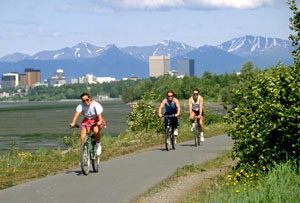
Anchorage is compact. The businesses are mostly tourist-pleasing shops selling knickknacks and Alaskan-made goodies. I bought my daughter some native jewelry and a friend some smoked salmon. There was a wonderful walking tour with historic old buildings and pictures of the gold rush, the entry into statehood and the catastrophic quake that nearly leveled the town in 1964. I rode the coastal bike trail and the original red trolley and wandered down to Ship Creek, where the banks were lined with fishermen. The salmon were running and every few minutes I’d hear a hoot and a holler and see a flash of pink flesh flop onto the shore.

Now I’m going to tell you something that may surprise you . Even shock you. There’s something very different about the people in this 49th state. They’re fiercely independent, incredibly quirky and extremely self sufficient. It’s a well known fact that the men outnumber the women and I was reminded of this my first night in Anchorage. While sitting at the bar, a weathered old woman told me “You know, the odds here are good if you’re a gal.” “Really?” I asked, only half listening since I already had my man. “Yeah,” she continued, “the odds are good – but the goods are a little odd.” Through a haze of cigarette smoke, I gazed at the room full of men and thought I saw someone winking.

In fact, a hilarious dinner show pokes fun at Alaskans and their propensity for strange things, like bear hunting and dining on reindeer and Spam. The live cabaret at Mr. Whitekeys’ Fly By Night Club has grown men dancing with fish, and the Spam – that famous spiced ham that comes gelled in a can – is featured in act after act . Oh, and it’s also on the menu. In fact, I’m certain it was on my hors devour plate, disguised as a coconut prawn.

You see, things are done differently in the land of the midnight sun. They play golf at midnight, and fish next to bears, and travel to places by dog sled or air. With very few roads in Alaska, you have to go airborne to see most of the state. But luckily, Anchorage is home to the world’s busiest seaplane airport, on nearby Lake Hood. It’s as easy as hailing a cab to hop in a plane and go, say, bear watching at Lake Clark National Park.

Just 90 minutes by air with Alaska Air Taxi, Alaska Homestead Lodge is where brown bears lumber freely through forests and meadows, never caring that a band of humans may be following them. Scratching their backs on a Black Spruce tree and digging for grubs in the dirt – they always return to the river. Our guide goes there too, and in minutes hooks a 12 pound spotted beauty. From the icy waters to the smoky grill in under an hour – this is the way to eat salmon.

No trip to Alaska is complete without a visit to Alyeska, the state’s largest ski resort. Even without skiing, there’s plenty to do in summer, like biking and hiking and walking on glaciers. With Red Bull for breakfast, you can accomplish all three and be soaking your blisters by dinner.

That leaves just one day to knock out the number one tourist activity in Alaska – a glacial cruise. You can do that in an hour with a quick cruise to the Portage Glacier, where thousand-year-old ice chunks float all around you. If you’re crazy like me, you’ll even take a taste of this finely aged ice when the captain brings some aboard.

Spot a moose, see spawning salmon – talk to ten guys who like bear hunting and oil drilling. Yep – you really can “do” Alaska in four days. But hang on to those energy bars – you may need them.

If you go:

Alyeska Resort
907-754-1111

Alaska Air Taxi
800-789-5232

Alaska Homestead Lodge
888-577-9383

Mr. Whitekeys’ Fly By Night Club
907-279-SPAM

Cross Country Adventure

Skiing Yosemite in Winter

Alameda Magazine, February 2005

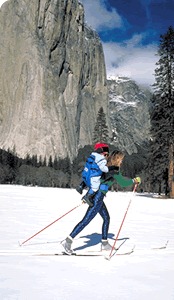
yosemite_skingIt’s one of the most popular National Parks in the country, ranked only behind the Grand Canyon and the Great Smokey Mountains. Yet Yosemite in Winter offers such solitude, you feel virtually alone. This is the season of opportunity to bond silently with nature, to take in the awesome splendor that John Muir and Ansel Adams breathed into their very souls.

It’s also a time for great adventure, as I found on a recent cross country ski trip from Badger Pass to Glacier Point. It was a test of endurance – in one of the most beautiful places on earth.

We started our trip in a snowstorm, at the base of California’s oldest ski area. Badger Pass still has the little brass bell that rings in the start of ski school and is the only ski area in a National Park today. But while the downhill runs are limited, the cross country terrain is boundless, restricted only by your imagination and your ability. On this particular day, we locked into our skis for a twenty one mile trek to Glacier Point and back. At our journey’s end we would be 8000 feet above sea level, with panoramic views of Half Dome, Nevada and Vernal Falls, and the twinkling lights of Curry Village below. We could see forever – if only the storm would pass.

Our group was a pleasant mix of men and women, some juniors and some seniors. Our skill levels varied but our common goal was to make Glacier Point by dinner, a powerful motivator when your stomach started yelping. Yes, dinner was being served by our guides, that night, in a cozy wood “cabin” that doubled as the Glacier Point gift shop in summer. But there would be no “thumbing a ride” to get there. Rangers only brought snowmobiles in emergencies – and sore legs were not an emergency.

Mile three and the flakes were falling faster. I was drenched with sweat and soaked with snow. I stripped off my parka and tied it around my waste, knowing my hood would hold a giant snowball by afternoon. But staying cool kept my energy up, and the shush of the skis on the snow-covered trail was almost zen-like. Mile six and we stopped for lunch. I plopped myself down in a bank near a tree and foraged through my backpack for a sandwich. It was peanut butter but it tasted like Filet Mignon. And my water tasted like fine Scotch. It went down smooth in a place where I was getting so much oxygen, I was giddy.

Mile nine and I was forming some pretty close bonds with my ski mates. Our collective sense of accomplishment was contagious. The trail, which had been steadily climbing, was ending in a long, gentle downhill run. Finally, we could let gravity take us home, to our cozy wood cabin with the wood burning stove on the edge of the world. All I could think of was food and a quiet place to lay my head.

“This is where you’ll sleep tonight,” said the guides, who clearly got a kick out of our reaction. Army cots were lined up like bunk beds, three deep. “You grab your own linen and earplugs, if you need them.” I grabbed two pair and headed for the couch near the crackling fire. Warming our toes, we shared quiet conversation and some wrote in journals. Others broke out the wine. By dusk, the snow had stopped falling and we could see Half Dome through the parting clouds. We strapped on our snowshoes (stocked at the cabin) and made our way to the end of the point, where we lay on our bellies in the snow. Below us, the valley floor looked like a twinkling toy village, with the lights of the Ahwahnee Hotel and the tiny skaters at Curry Village, looking like miniatures gliding across a music box.

This was why we came up here. With nothing more than our mettle and a sense of adventure, we’d made it to the end of the rainbow. And the pot of gold – was an experience none of us will ever forget.

There are nearly 350 miles of skiable trails and roads in Yosemite National Park. For information about recreation and lodging, visit http://www.yosemitepark.com or call 559-252-4848. For 24-hour ski conditions, call 209-372-1000. For road and weather information, call 209-372-0200, or visit www.BadgerPass.com.

Just Another Day At Olympic Park

Reliving the Winter Games in Utah

Oakland Magazine, February 2005

It’s winter. We can either crawl under a quilt and snuggle till spring, or embrace mother nature and her frosty disposition. If you’re like me, you choose to celebrate this season of chapped lips and pink cheeks. Donning knit cap and gloves, you may even stick out your tongue as the fat, juicy snowflakes swirl around you. And some of the best snow on earth is a short flight from Oakland – in Utah.

skiing_photoJust an hour from Salt Lake City, Olympic Park is the epicenter of your winter experience. Here, the 2002 winter games are still fresh in the minds of the people who visit, and training goes on here, year-round. But if you’re not content to see someone else have all the fun, you can try some of the sports yourself.

Take the bobsled, for instance. For 200 dollars, you can go flying down the Olympic bobsled run at speeds of up to 80 miles per hour. With a certified driver and 2 other riders, you whisk around 15 curves and descend almost 40 stories in less than a minute. It’s the most jaw-dropping, bone knocking ride you can imagine and there is no denying, it’s fun.

Then there’s freestyle ski jumping, a sport that only a human pretzel can love. You can learn this here too, with instructors who teach on terrain parks in winter and special ramps in summer that have you jumping into an aerated pool. The bubbles cushion the blow when you land with your skis in a tangle and arms all akimbo. But with just a few lessons, you may even learn to stick your landing.

Now I know what you’re thinking. Is there anything in the area that’s a little more – tame? The answer is yes, with two world class facilities for skating and cross country skiing. Framed by the rugged Wasatch Mountains, Soldier Hollow was the site of the 2002 Cross Country and Biathlon events. You can just picture the scores of spectators lined along the tracks to watch the competition. Today, you’ll find youngsters to seniors navigating these 21 miles of trails, with state of the art rental skis and terrain for all skill levels. But even more challenging is the combination of skiing and shooting called Biathlon. Imagine skiing around the track to the air rifle range, where you drop to your belly and take aim. Your legs in a V- shape behind you, the trick is to steady yourself and stop shaking long enough to hit the target.

But not everything here mirrors the Winter Games. You can rent snowshoes and explore some of Soldier Hollow’s 600 plus acres of woods and meadow. You may even see a moose along the way, or some of the other wildlife that calls Utah home. For the young at heart, try plopping your body into a big rubber tube and sliding down the hill. Soldier Hollow has the longest Snow Tubing lanes in the U-S – and a tow lift to take you to the top. Even a certified couch potato could learn to like this “sport”.

The final crown jewel in Utah’s Olympic experience is the Oval Ice Skating Rink. Called the fastest ice on earth, you can lace up your skates and feel the wind in your hair as you fly around the same 400 meter speed skating track the Olympians used. And setting your sites for loftier goals is as easy as skating up to the aerial bungee stations. Much like it sounds, you’re lifted 25 feet in the air for a chance to do back flips and other trick maneuvers before making a soft, gentle landing. It takes no experience – just strong will and nerve.

The 2002 Winter Olympics have forever changed Salt Lake City and its surrounding area. They have world class training facilities now, which American athletes will use for decades to come. We can use them too – making Utah one of the best family vacation destinations in any season.

OPEN YEAR ROUND

Utah Olympic Park
Toll-Free: 1-866-OLY-PARKS
www.utaholympicpark.com

Soldier Hollow
(435) 654-2002
www.soldierhollow.com

Utah Olympic Oval
801.968.OVAL (6825)
www.utaholympicoval.com

Kayaking the Channel Islands: Where the Risk is Worth It!

(Alameda Magazine, July/August 2004)

kayakingSince the beginning of time, man has been fascinated with caves. Dark, dank and mysterious, they test the very depths of our imagination. But while man lived for centuries in caves on dry land, it’s sea caves that offer the real adventure. And no place in California has more sea caves than the Channel Islands.

First, a geography lesson. The Channel Islands are eight spits of land off the Southern California coast. They lie in a spot between the mainland and the deep ocean called the Continental Shelf. There’s an amazing array of wildlife and water so clear, Jacque Coustou once called it one of the best cold water diving spots on the planet. Oh, and something else. We own these islands. They’re part of the National Park system.

On a day when the fog was skirting the sun, I joined a group of kayakers on a trip to the closest island in the chain, Anacapa. We left out of Oxnard, about an hour north of Burbank and just below Santa Barbara. It’s a wonderful town that really needs a name change (remember the Johnny Carson jokes on the Tonight Show?) But that’s a story for another time.

The boat trip to Anacapa is not for the weak of stomach. Dramamine and a steady eye on the horizon helped me through the 90 minute excursion, which was more like a liquid roller coaster ride. But once we were in our kayaks, the waves were gentle and easy to ride.

Anacapa is a long, skinny spine of cliffs and caves that the Chumash called “Anyapakh”, or mirage. Our guide was most aptly named, Jimmy McWaters. “People have been hurt in these caves and you have to be careful,” he warned as we adjusted our helmets and paddled into a circle around him. He watched, intently, the swell of the sea. “If the tide is too high or low, you can get trapped,” he went on, adding that he had his own scrape with death in a sea cave. “I was trying to turn around and a swell came in and lifted my kayak up and I got wedged on the ceiling.” Perhaps too much information was coming our way.

But once I saw the treasure inside, I was convinced that the risk was worth it. A kaleidoscope of color encircled the walls, with sea stars of purple and magenta. Tiny crabs scurried along the dripping rocks. And something else was in there. I could see it on a ledge when Jimmy shined his flashlight. It was a Sea Lion with deep, dark eyes and whiskers like a broom. This was clearly his cave and his barking echoed off the cavern walls.

In and out of the sea caves we paddled, riding the tides and marveling at the marine life. If ever there were an amusement park for this sport, the Channel Islands would be it. Off Anacapa alone, there are more than 120 sea caves. Some are big, with wide open entries. Some are tiny, barely allowing a kayaker to enter before being spit back out with the tide. Guides have names for caves like these. Names like Room of Doom and Flatliner. The novice kayaker may want to sit these caves out. But then there are places like Painted Cave off Santa Cruz island. One of the world’s largest sea caves, it’s big enough to house a blimp. In fact, Santa Cruz has over 150 caves on its front side alone. It’s the biggest of the Channel Islands and is thought to be a miniature of what Southern California looked like more than a century ago.

On longer trips you can beach your kayak and hike the trails on several of the islands. Snorkeling is also a popular sport. And if all this doesn’t do it for you – there’s always sex. With waters so clear, you can see the male Garibaldis luring the ladies into their kelp dens. When the passion has ended, the females take off – leaving the men to raise the minnows. It’s a show that goes on daily in the Channel Islands chain.

For more information on Channel Islands National Park, call 805-658-5730 or log on to http://www.nps.gov/chis.


Seeing Oakland Through the Eyes of a Travel Writer

(Oakland Magazine, July/August 2004)

You’re planning your vacation. You see yourself having incredible adventures, capped off with an elegant dinner and electrifying nightlife. You’re thinking Costa Rica, Bora Bora–maybe New Zealand. But before you book globally, think locally, because there’s a world of adventure in your own backyard.

Seeing Oakland through the eyes of a travel writer is something I do often as a freelance journalist living in Montclair. What other big city offers miles of open space with winding trails and sweeping vistas, a bustling sea port and one of the most diverse populations in the country? Oakland may get a bum rap from some, but I’ve never met a travel journalist that didn’t like it here. So let’s go exploring and celebrate the sunny side of the bay. Right after breakfast.

It’s a well known fact that the morning meal is critical, especially when you’re touring, and The Montclair Egg Shop is known city-wide for its hearty omelets. In a cozy cafe with a model train that goes clickety clack on an overhead track, this place is all it’s cracked up to be, and more. It’s also located in one of the Bay Area’s most charming neighborhoods, Montclair Village. Nestled in the Oakland hills, Montclair’s old fire station and library feature the story book architecture seen often in Oakland. But surrounding this village is something even more unique–miles and miles of parkland and water shed, where you can hike for days and rarely see another person.

But you can see a llama. In fact, you can rent one to carry your pack on a hike through Roberts Regional Park. Open to everyone, these llama hikes can be booked through the East Bay Regional Park District several times a year. On a recent outing with some out of state travel writers, I led my buck-toothed friend “Freckles” along the dusty tree-lined trail. Contrary to what you may have heard about llamas, he never spit once. He did, however, make funny low-pitched noises that sounded like a cow with laryngitis.

While the llama trek may be an Andean-like adventure, the Oakland hills have parks that are reminiscent of other faraway places. Sibley Volcanic Regional Preserve reminds me of Ireland, with its velvet green crests and vast, sweeping views of the mountains and sea. In winter and spring, nearby Redwood Regional Park is so dense with vegetation, it resembles a rain forest. Waterfalls tumble from granite rocks into steep canyons. All this is just minutes from downtown Oakland, and as nature tends to be–it’s free.

Gondola ride on Lake Merritt

Gondola ride on Lake Merritt

But not everyone find solitude on a dusty trail. If it’s urban fitness you’re looking for, then catch the morning stroll at the nation’s oldest wildlife refuge, Lake Merritt. While the bird-watching is good, the people-watching is even better, with regular sightings of Oakland’s celebrity mayor (Jerry Brown) on a jog with his dog. Speaking of sights, along the shores of this great urban lake is a magical place that some say was the inspiration for Disneyland. When Walt Disney came to Children’s Fairyland in 1954, he was so impressed, he hired the director away at double her salary. Some 59 years later, fairy tales still come alive here and so do innovative ideas, like Fairyland’s summer overnights for families to pitch tents and see puppet shows under the stars.

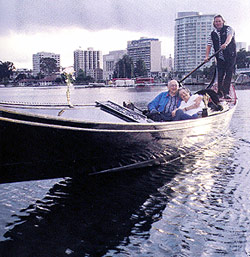
Oakland is a mariner’s paradise and Lake Merritt is no exception. At the Boathouse you can rent sailboats and other non-motorized vessels for a leisurely cruise. But for something really different, book a ride in an authentic Venetian gondola. With a handsome gondolier at the helm, you feel like royalty as you glide across the placid waters. All around you are the skyline and city, and the lights of lake Merritt–like a romantic string of pearls.

Then there’s a nautical adventure that is more–interactive. Sea kayaking on the Oakland Estuary. California Canoe & Kayak has dozens of colorful kayaks in the water at Jack London Square. Take one out (instruction is available) and tour the waterfront that Jack London made famous in his adventure novels. You can even see a replica of his cabin in the square next to one of his favorite watering holes, the 121 year old Heinhold’s First & Last Chance Saloon. Like a scene from John Barleycorn, Heinhold’s is still serving ’em up–frothy and cold. On foot or by boat, Jack London Square is great for exploring, and just blocks from the perfect place to have lunch–in a gingerbread house. Though it’s certainly not real, it almost looks edible -the candy-cane pillars and chocolate brown bric-a-brac make T.J.’s Gingerbread House irresistible to passers-by. Even more enticing is their Cajun-Creole cooking, which T.J. Robinson learned from watching her grandma cook in Louisiana. Jambalaya, cracked crab and cornbread–served in a fairytale setting. No wonder this place still has a line out the door many nights.

In some countries, a good lunch calls for a good nap. In the Bay Area, it calls for a spa treatment. And while a massage can aid in digestion, it’s more fun to think of it as pure indulgence. It’s the underlying theme at The Claremont Resort and Spa. With treatments so exotic, you’ll dream you’re in far away places–the term “out of body experience” must have been coined here. Perched majestically on a hilltop, the grand lady is also a very hip place for happy hour, with it’s long luscious views of the Oakland and San Francisco skylines. The Paragon Bar takes full advantage of the scene with almost every seat near a window or on the outdoor deck.

When dinner calls, Oakland answers with so many top-rated restaurants, it’s impossible to choose. One place that garners great revues is the chic and sexy A Coté on College Avenue, where the long queues for dinner testify to its popularity. Since this restaurant takes no reservations, be prepared to window shop while you wait.

Or you can head for Old Town Oakland, a much more subdued setting for an evening repast. There are several good restaurants here, including the popular Vietnamese café called Le Cheval. But for a quiet, comfortable meal, my favorite place is Twist, in the historic old Washington Inn. In the 1870s, Old Oakland was the heart of the town, with its grand Victorian hotels built for travelers coming in on the Transcontinental Railroad. The Washington Inn still operates as a boutique hotel today, and the atmosphere and Italian food are superb. It’s also close to one of the hottest spots for nightlife in Oakland, Yoshi’s World Class Jazz House. Everyone from Joe Sample to Diana Krall comes to play here, and there’s no bad seat in the house.

Walking out of Yoshi’s the other night, I watched the fog role in from our famous neighbor to the west. It’s clammy fingers tried to pull me toward it, toward the city that always seemed to steal the spotlight. “Not this time,” I thought to myself. This time it’s Oakland’s time to shine.

If you’re going:

  • Montclair Village 510-530-8052 or visit www.montclairvillage.com
  • East Bay Regional Park District 94,500 acres with 1150 miles of trails. 510-562-PARK
  • Children’s Fairyland 699 Bellevue Avenue–open year round. Admission $6 including unlimited rides. Adults must be accompanied by a child. 510-452-2259
  • Gondola Servizio Lake Merritt Boathouse. Open year round. Reservations required. Call Monday through Friday from 10-2pm. 510-663-6603
  • California Canoe and Kayak 409 Water Street in Jack London Square . Open year round. Kayak rentals start at $15 per hour. Canoes–$25 per hour. 510-893-7833
  • Heinhold’s First and Last Chance Saloon 56 Jack London Square. 510-839-6761
  • T.J.’s Gingerbread House 741 Fifth Street. Open for lunch and dinner Tuesday through Saturday. 510-444-7373
  • Claremont Resort and Spa 41 Tunnel Road. 510-843-3000
  • A Coté Restaurant 5478 College Avenue. Lunch Tuesday through Saturday. Dinner Tuesday through Sunday. 510-655-6469
  • Twist Italian Restaurant 495 10th street in the old Washington Inn. 510-832-7449
  • Yoshi’s 510 Embarcadero West. Open nightly for dinner and jazz. Reservations recommended. 510-238-4551

Loving Lodi

Where Getting Stuck is Worthwhile

(Alameda Magazine, May/June 2004)

lodi1Mention Lodi and baby boomers picture a town so dull, the band Credence Clearwater Revival once wrote a song about it. But these days, being “Stuck in Lodi, again” is a good thing. Less than 90 minutes from Alameda, Lodi is a world apart from Stockton and other Central Valley neighbors. “There’s a spike in home prices when you get to Lodi,” one realtor told me, and the reason is plain to see. The town is as neat as a pin–with a thriving downtown shopping district and its own wine country.

Head north on I-5, past the farms and the truck stops and the endless miles of fast food outlets, and just north of Stockton you’ll see the landscape change. Turn east onto Highway 12, and vineyards and fruit stands now dot the countryside, with freshly painted homes tucked neatly between acres of farmland. Just 7 miles away–Lodi starts to draw you in.

Nestled along the Mokulemne River, the town is a shady respite for sun-baked Delta travelers. Forty wineries make their home here, including Woodbridge and Michael David–known for its popular “7 Deadly Zins”. Your first stop should be the new Lodi Wine and Visitor’s Center, where you can taste top local wines, learn about the region and pick up a wine trail map. Unlike Napa, Sonoma and even Livermore–the wine trail here is a pastoral delight–devoid of traffic and crowds. It’s the quintessential country road, with acres of old Zinfandel vines and enormous Valley Oaks.

Just minutes from the vineyards is the downtown of my dreams. With a mission-style arch at its entrance, The heart of Lodi is lined with wonderful shops and bakeries and a bustling new multiplex theater. Farmers bring fresh organic vegetables to the open air market and they’re snapped up in minutes. The bus and train station nearby are immaculate–and within walking distance of the shops. This is a town with strong German roots and a community pride that’s contagious.

lodi2No trip to Lodi would be complete without a visit to the town’s premier property–Wine and Roses Hotel. It’s a beautiful country estate with acres of flowers and manicured lawns and plush, Victorian rooms. It’s easy to see why weddings are so popular here, but it’s also the local’s favorite. The restaurant is exceptional, with much of the food grown organically in the fertile fields nearby. Even the duck is raised locally, and the flavor rivals anything you’ll find in the Bay Area’s top restaurants. What’s different is the way you feel when you’re here–like an old friend. Owner Russ Munson sees to this, stopping by each table to greet his guests. The night I was there, I was even invited to sing at the piano–with the wonderful Rudy Tenio, who’d been playing music all day in the cool delta breeze. Hours after his “gig” had ended, he obviously felt the way I did–that this place was too special to leave. Being in Lodi was a good thing. I can’t wait to be “stuck” there, again.

For more information on Lodi http://www.visitlodi.com , the Lodi Wine and Visitor’s Center at www.lodiwine.com, The Lodi Conference & Visitors Bureau at (209) 365-1193, or Wine & Roses Hotel at (209) 334-6988.

There’s a Fungus Among Us

Alameda Living Magazine, Nov.-Dec. 2003

mendocino_mushroomThere’s a fungus among us–and this is a good thing. With winter approaching, the earth is releasing a splendiferous spread of edible roots and shoots and ground zero may well be Mendocino County. Here, where the Redwood forests thrive on the moist, salty air, mushrooms spring from the nutrient rich soil. With each gentle rain, the tender young caps push up from the ground and beckon to be browned in white wine and garlic.

The celebration of earth’s erotic bouquet takes place each November with the Mendocino Wine and Mushroom Fest. Like a fine progressive dinner, dozens of restaurants and inns put on a feast. One of my favorite stops is the Inn at Schoolhouse Creek, where a warm crackling fire throws shards of light on the rich parlor walls. Comfy chairs and shelves of good books invite you to linger and savor the flavor of mushroom pate–a good Chardonnay–and an array of delicious hor devours. Down the road, Alexander Valley wine flows as freely as the conversation at the Little River Inn. It’s Mendocino’s oldest coastal resort with sweeping views of the wild, crashing surf and regular sightings of spouting whales. It’s an intoxicating mix of spirit that draws people to this untamed paradise. As one local told me, “No matter what we’ve accomplished, we’re all equal here. We’ve all come for this love affair with nature.”

On a dew-kissed morning, we board the Skunk Train and journey deep into the Redwoods for an all-day mushroom symposium. The smell of grilled Portobellos is enough to lure fairies from their forest hideaways. Charmoon Richardson is the chef, whose name came to him during a childhood “epiphany” under a tree. He’s here with other “shroomies” like Eric Schramm, whose company Mendocino Mushrooms sells 50,000 pounds of wild mushrooms a year. One by one, they step up to the microphone, sharing secrets and tips and fantastical tales.

Soon it’s time to test our skills, with a good old fashioned mushroom hunt–a foray for fungus that has us scouring the woods for tender young caps and shoots. Identification can be tricky, but there are enough experts here to tell a Crimini from a Candy Cap. We search under tree stumps and leafy debris and call out when we find a mushroom colony. It’s the ultimate treasure hunt and it takes nothing more than a set of sharp eyes.

For some, food is art. Local photographer Taylor Lockwood uses these botanical beauties as subjects for his world renowned pictures. Others make paper from the mushroom’s weighty stock. All these art forms are discussed and displayed during the Mendocino Wine and Mushroom Fest.

If you’ve found, as I have, that you’re mad about mushrooms–the festival helps you here, too. You’re invited to take home your own growing kit. This way you’ve got wine and mushrooms in the cellar, ready for your next gourmet meal.

The 12 day Mendocino Wine and Mushroom Fest takes place November 12-23. Festivities include winemaker luncheons and dinners, cooking classes, guided mushroom walking tours, demonstrations and exhibits. For more information, call the Mendocino County Promotional Alliance at 1-866-GoMendo or log on to www.gomendo.com

About Livermore Wineries

Alameda Living Magazine, 2003

livermore_wineriesIt was a balmy spring night when I first fell in love. Maybe “crush” was more like it, considering the object of my affection. I raised my glass and toasted the sunset–the wine blush fresh on my cheeks as I celebrated my affair–with the lush rolling hills of the Livermore Valley Wine Country.

While most people think of Napa and Sonoma as “the wine country”, Livermore is California’s oldest wine region. In fact, it was a Livermore Valley wine that won the first Gold Medal for California at the Paris Exposition in 1889. Today, the combination of exceptional soil and an abundance of chemists from nearby Lawrence Livermore Lab has spawned a number of exceptional boutique wineries.

Winding your way east along Interstate 580, take Vasco Road south toward the Wente Vineyards. This is the valley’s oldest continuously operated family-owned winery. The Tasting Room has a picturesque picnic spot at 5565 Tesla Road, where you can sample wines daily from 11 to 4:30. Continue southwest on vineyard laced country road and you end up a splendid estate nestled against velvety green mountains. This is the Wente Restaurant and Visitors Center. This is where true love begins. Settle into the sumptuous dining room and sip one of five hundred wines from California and beyond. Get lost in the fragrance of the flowering trees and the aroma of fresh herbs and sauces coming from the kitchen. The views of the golf course and beautifully manicured grounds are as appealing to the eye as the food is to the palate. Top dinner off with a summer concert in the vineyard (June through September) and you’ll see why the Zagat Survey lists Wente as one of America’s top restaurants.

livermore_grapesOther wineries bring their own special charm to the Livermore Valley. Tucked away in a grove of ancient pepper trees, is a little giant called Retzlaff. Not only are these boutique wines extraordinary, they are all organic–made by hand from grapes grown on site with no fertilizers, herbicides or pesticides. How do owners Bob and Gloria Retzlaff do it? Naturally. They put up a hawk house and a hawk moved in to prey on the Starlings. The built an owl roost and the owls keep the gophers and mice at bay. So do the vineyard cats and the couple’s border collie. It works beautifully, as Retzlaff has some of the tastiest wines and most charming picnic grounds in the Livermore Valley. Open to the public, they host annual events for Mothers and Fathers Day, the Fourth of July, and a homegrown celebration called the “Howl at the Moon Dinner” on September 13th. Retzlaff Vineyards is located at 1356 S. Livermore Avenue. Open for tasting Tuesday Friday from 12-2 and weekends from 12-4:30.

No trip to this region would be complete without visiting Concannon–a vineyard that goes back to Livermore’s early wine making days. While Robert Livermore planted the first commercial vines in the 1840s, pioneer winemakers C.H. Wente, Charles Wetmore and James Concannon founded the first wineries in the early 1880s. They were the first to bottle varietally labeled Chardonnay, Sauvignon Blanc and Petite Sirah. Concannon is still going strong today, producing award-winning wines at its historic site at 4590 Tesla Road. They offer tasting daily from 11-4:30.

The Livermore Valley Wine Country has over 5,000 acres of vineyards today, with over 24 wineries and a number of top notch golf courses. Laced between acres of new high end homes, you may be tempted to relocate here. As the sign says–“If you lived here, you’d be home now”. Home amongst the vineyards and some of California’s oldest and most flavorful wines. For more information, log onto www.livermorewine.com or contact the Tri-Valley Convention and Visitors Bureau at 1-888-874-9253.