Sonoma Wine Country Holds Autumn Charm

MONTCLARION NEWSPAPER

– SEPT. 30, 2006

WHEN YOU THINK of autumn leaves, you probably think of New England — or maybe the Midwest. Their stands of fiery maples and golden birch are so resplendent; they call to a whole class of tourists called Leaf Peepers.

But here on the West Coast, we have our own fall color. It peaks more toward winter and is every bit as beautiful as a deciduous forest. It’s the wine country, where the leaves on the vines blush brilliant shades of burgundy and gold. It’s nature’s great show, and the timing couldn’t be better, as the crush is just ending and the vineyards sleep silently until spring.

The Sonoma wine country is simply gorgeous this time of year. The days near Halloween are a cacophony of color for grape-growing regions like Dry Creek and the Alexander Valley. Head north on Highway 101 to Santa Rosa and stop for a cup of coffee at the historic Railroad Square. Locals and tourists alike come here and you’ll feel the energy as you browse the antique shops and the hip cafes. It’s a great launching point for your fall color tour and tastings.

With Santa Rosa as your starting point, you can choose from three colorful country drives. All are lightly traveled and incredibly romantic this time of year. The northern route takes you through one of my favorite places, Healdsburg. Lovers still stroll hand-in-hand in this charming town, window shopping and exchanging pleasantries with neighbors and merchants on the street. Healdsburg is known for its restaurants, which feature a bounty of meats and produce raised in the region. You’ll find everything from Muscovy duck to goat cheese and Pacific oysters, any of which can be packed for an afternoon picnic. From town, head toward Highway 128 for a delightful drive through the Alexander Valley. There are 28 wineries in this region, and more than 15,000 acres of vineyards blanketing the valley and surrounding hillsides. The wines run the gamut from soft cabernets to rich chardonnays and newcomers like French syrah and Italian sangiovese.

The second route takes you west from Healdsburg through the cooler climates of the Russian River appellation — perfect for pinot noir. There are 50 wineries in this region as you wind your way toward Jenner and the Pacific Ocean. In early November, you’ll still see pumpkins on the vines, along with colorful flower farms and places to cut your own Christmas trees.

If a warmer climate suits you, the third route takes you southeast from Santa Rosa along Highway 12 — through Sonoma’s famous Valley of the Moon. This is where Franciscan Padres planted the county’s first grapes in 1823 and you can still see the ancient winery stone shells today. With charming old towns like Sonoma and Glen Ellen, Highway 12 is a favorite route through a region that produces everything from peppery zinfandel to buttery cheese.

While cars and motorcoaches are the easiest way to tour the Sonoma Wine Country, they may not be the most satisfying. Consider riding a bike along the miles of flat and gently rolling roads that traverse the vineyards.

There’s a sweetness to the air as you ride past fields and farms and stop to taste a grape or two. On a bike you can take your time to stop at the bounty of boutique wineries that dot the country lanes.

If adding a little horsepower to your vehicle sounds better, you can do it, literally, by renting a horse-drawn carriage from Flying Horse Carriage Co. Using elegant coaches and well-behaved draft horses, they take you on a delightful ride through the Alexander Valley, where the sounds of the wagon wheels and the horses hooves almost lull you to sleep.

The owner and coachman, Bret Le Rolland, loves to stop and pick you a grape, then compliment it with a glass of wine and fine cheese. For sunny days he provides parasols — on cooler days, blankets. Along the way, he points out things of interest as the horses climb the hillside for a gorgeous view of the valley below.

There’s another way to see the Sonoma Wine Country, if you have the stomach. Just south of Sonoma is a regional airport where Chris Prevost keeps his planes. Not just any planes, but vintage World War II planes with open cockpits. Just say the word and he’ll show you a view of the wine region that few get to see. Donning a parachute and leather helmet, you climb the ladder to the cockpit where you’re strapped in for a thrill ride of dips and turns that are as mild or as wild as you request. Chris takes you low over long-lashed cows and fields of clover, then up for a wide-angle view of the valley and beyond. It’s one of the best ways to see the Sonoma Wine Country.

So pack a blanket and a thermos of soup, and head north this fall for some of the best autumn colors on Earth. When it comes to seasons — Sonoma can hold its own with the best of them.

If you go there:
Sonoma County Convention and Visitor's Bureau
800-404-7673

California Wine Country Bike Tours
866-922-4537

Flying Horse Carriage Co.
707-849-8989

Vintage Aircraft Co.
707-938-2444

Sonoma Wine Country Holds Autumn Charm

WHEN YOU THINK of autumn leaves, you probably think of New England — or maybe the Midwest. Their stands of fiery maples and golden birch are so resplendent; they call to a whole class of tourists called Leaf Peepers.

But here on the West Coast, we have our own fall color. It peaks more toward winter and is every bit as beautiful as a deciduous forest. It’s the wine country, where the leaves on the vines blush brilliant shades of burgundy and gold. It’s nature’s great show, and the timing couldn’t be better, as the crush is just ending and the vineyards sleep silently until spring.

The Sonoma wine country is simply gorgeous this time of year. The days near Halloween are a cacophony of color for grape-growing regions like Dry Creek and the Alexander Valley. Head north on Highway 101 to Santa Rosa and stop for a cup of coffee at the historic Railroad Square. Locals and tourists alike come here and you’ll feel the energy as you browse the antique shops and the hip cafes. It’s a great launching point for your fall color tour and tastings.

With Santa Rosa as your starting point, you can choose from three colorful country drives. All are lightly traveled and incredibly romantic this time of year. The northern route takes you through one of my favorite places, Healdsburg. Lovers still stroll hand-in-hand in this charming town, window shopping and exchanging pleasantries with neighbors and merchants on the street. Healdsburg is known for its restaurants, which feature a bounty of meats and produce raised in the region. You’ll find everything from Muscovy duck to goat cheese and Pacific oysters, any of which can be packed for an afternoon picnic. From town, head toward Highway 128 for a delightful drive through the Alexander Valley. There are 28 wineries in this region, and more than 15,000 acres of vineyards blanketing the valley and surrounding hillsides. The wines run the gamut from soft cabernets to rich chardonnays and newcomers like French syrah and Italian sangiovese.

The second route takes you west from Healdsburg through the cooler climates of the Russian River appellation — perfect for pinot noir. There are 50 wineries in this region as you wind your way toward Jenner and the Pacific Ocean. In early November, you’ll still see pumpkins on the vines, along with colorful flower farms and places to cut your own Christmas trees.

If a warmer climate suits you, the third route takes you southeast from Santa Rosa along Highway 12 — through Sonoma’s famous Valley of the Moon. This is where Franciscan Padres planted the county’s first grapes in 1823 and you can still see the ancient winery stone shells today. With charming old towns like Sonoma and Glen Ellen, Highway 12 is a favorite route through a region that produces everything from peppery zinfandel to buttery cheese.

While cars and motorcoaches are the easiest way to tour the Sonoma Wine Country, they may not be the most satisfying. Consider riding a bike along the miles of flat and gently rolling roads that traverse the vineyards.

There’s a sweetness to the air as you ride past fields and farms and stop to taste a grape or two. On a bike you can take your time to stop at the bounty of boutique wineries that dot the country lanes.

If adding a little horsepower to your vehicle sounds better, you can do it, literally, by renting a horse-drawn carriage from Flying Horse Carriage Co. Using elegant coaches and well-behaved draft horses, they take you on a delightful ride through the Alexander Valley, where the sounds of the wagon wheels and the horses hooves almost lull you to sleep.

The owner and coachman, Bret Le Rolland, loves to stop and pick you a grape, then compliment it with a glass of wine and fine cheese. For sunny days he provides parasols — on cooler days, blankets. Along the way, he points out things of interest as the horses climb the hillside for a gorgeous view of the valley below.

There’s another way to see the Sonoma Wine Country, if you have the stomach. Just south of Sonoma is a regional airport where Chris Prevost keeps his planes. Not just any planes, but vintage World War II planes with open cockpits. Just say the word and he’ll show you a view of the wine region that few get to see. Donning a parachute and leather helmet, you climb the ladder to the cockpit where you’re strapped in for a thrill ride of dips and turns that are as mild or as wild as you request. Chris takes you low over long-lashed cows and fields of clover, then up for a wide-angle view of the valley and beyond. It’s one of the best ways to see the Sonoma Wine Country.

So pack a blanket and a thermos of soup, and head north this fall for some of the best autumn colors on Earth. When it comes to seasons — Sonoma can hold its own with the best of them.

Autumn in the Gold Country

TGIF. Thank God it’s fall. No more “spare the air” days. No more stubbing my toe in flip-flops. No more slathering of sunscreen every few hours. My wool suit is out and I’m not afraid to wear it.

Autumn is a time for long, lazy drives in the country. I took one of those trips the other day — to revisit a place I hadn’t seen in years — California’s Gold Country. I’d booked a room at the oldest inn in Sonora, the Gunn House Hotel. Charming rooms, plump comfy beds with bears on them, a breakfast parlor you could spend the day in — with warm walls and a stone fireplace accented by antiques and assorted knick knacks. Oh, and did I mention, they have a ghost? A specter is something most inn owners would kill for — pardon the pun, and this hotel has a friendly one, albeit mischievous. I never saw this spirit but just knowing she was there “fed” my adventure.

I’d heard about a winery not far from Sonora called Ironstone. Two of my favorite bands were playing there that night — Heart and Kansas. I loaded up my lawn chair and programmed my car’s GPS for Murphys, a charming boutique town a mile from the vineyards. It was like a boomer convention, with scores of 50-something tourists killing time before the concert. The town’s Irish pub was hopping like the Calaveras Frog Jumping Contest and I grabbed a beer before heading for the winery.

Ironstone is a surprising operation. With 1,150 acres, you can spend hours strolling the beautifully landscaped grounds, touring the wine caves and tasting the fruits of their labor. The world’s largest Crystalline Gold Leaf specimen is on display in their Heritage Museum, a priceless eye-popping piece that embodies the spirit of the Gold Rush. And outdoor concerts are held in an amphitheatre with sweeping views and grassy tiers that are perfect for blankets and low-backed chairs. The smell of barbecue lures you into the festival-like atmosphere where wine is sold in plastic carafes.

Yes — fall is a fantastic time of year. The weather cools and the Aspens shimmer and folks settle into their Autumn rhythm. And I explore. In my wool suit, I get out and discover America.

Or at least the part that’s within a few hours of home.

FREEWAY FOLIAGE: Remember Caltrans’ promise to plant greenery along that now barren stretch of Highway 13? Well, the digging will begin next spring, to the tune of $500,000. That’s a lot of bushes — 780 to be exact — all hand picked by our local politicians and a group of concerned citizens.

The shrubs along the new barrier will include Barberry (an evergreen with seasonal orange-yellow flowers and dark blue berries); Lemonade Berry (an evergreen with leathery green leaves and white/pinkish flowers); and my favorite, the Smoke Tree (a deciduous shrub that has “puffs of smoke” formed by fuzzy lavender/pink hairs). Puffs of smoke mingling with puffs of exhaust — something to look forward to in those commute-time traffic tangles.

CARD CLUB: Imagine playing bridge with the same group of women for 40 years. Local senior Lillian Cadenasso says that’s how long she and her partners have been playing cards and donating money to the Corpus Christi School library. When they started, they had four times the number of players that they have now.

“Young people are so busy with the school and kids,” she says. Still, their core group meets once a month for three hours and gives almost $500 annually to an institution that most of their children attended.

“I had eight kids at Corpus Christi,” says Cadenasso, who says in those days they charged by the family, not by the student. “People could afford those kinds of families back then,” she reflects.

Beginners and experienced players alike are invited to join their bridge group. Contact the school for more information.

FIDO’S FREEBIES: There’s no such thing as a free lunch, but with four legs and a bark you get free dessert on Park Boulevard. Reader Jeanne Cahill says the guys at Glenview Hardware give out the best dog cookies in town, free to any pooch who comes in the door.

“Our friends across the street baby-sat our dog and were astounded when he refused to walk by the store without stopping in” Cahill writes. Now that the secret is out, I’m sure the guys at the hardware store will be “hounded” for free cookies.

Quick Thinking Eagle Scout Puts Out Fire

FALL IS FIRE season. And while some of us run in the other direction when we spot flames — two hills Eagle Scouts did just the opposite on a recent outing in the Sierra. They stopped to put out a blaze that could have turned into a major wildfire.

John Callon and Dan Langmaid were backpacking in the Hoover Wilderness just north of Yosemite when they happened upon a small forest fire. It was windy that morning and the flames were spreading quickly. The youths did what they could to shut off the fuel supply, isolating the burning logs and throwing dirt on the fire.

Soon, reinforcements came — three other members of the hiking party who found water about 300 yards away and ferried it back to the fire in bottles, pots and even their backpack rain covers. When the smoke got too thick, they covered their mouths with bandannas and kept working.

Meanwhile, Callon took off running seven miles to the nearest U.S. Forest Service station to report the blaze. By nightfall, the fire was out and the surrounding forest and dwellings were safe.

It takes a big commitment to be an Eagle Scout — with years of meetings and training and service projects. Not many boys are willing to put in the work. Thank God, Callon and Langmaid did, and knew what to do when they spotted trouble. It’s a testimony to the Boy Scouts and to a generation of youth who take their responsibility to the community seriously.

Like most scout groups, Troop 206 needs more members. If you know a boy between the ages of 11 and 16 who would like to join, contact Scoutmaster Tim Bever at beverclan@comcast.net. The Troop meets Thursday evenings at 7:30 p.m. at the Joaquin Miller Park building on Joaquin Miller Road.

FOREIGN TONGUES: If you’re planning a trip to Moscow or St. Petersburg anytime soon, you may want to bone up on your Russian. The Oakland Rotary Club is offering free Russian lessons on Tuesday nights, at their Franklin Street location. Why Russian? Two reasons, really — member Don McClure speaks it fluently and the club is also bringing over 12 lawyers from Russia so they can learn about the American legal system. “If we could teach people Russian,” says past president Tom Schmitz, “then maybe we could seduce them into being home hosts.”The Russians are coming Oct. 13 (and staying until Nov. 4) and you can learn more about the program, and the Russian lessons, by calling Jo Pegrum at 510-547-4473.

WANING SUMMER: September weather is perfect for soaking up those last rays of summer.
Reader Sue Piper suggests rounding up your friends and having a picnic this Sunday, Sept. 17 at the Woodminster Amphitheater. Michael Morgan will be conducting the East Bay Oakland Symphony in a free concert at 3 p.m. It’s part of four consecutive Sundays of music at Woodminster, put on by Oakland Parks and Rec. For more information call Karis Griffin at 510-238-3052.

EMBRACING DANCE: Thanks to reader Nelly Truong (Nelly’s Java) for inviting readers to the grand opening of her husband’s new ballroom dance hall. “It’s one of the largest in the Bay Area,” says Truong, who says the brand new 10,000-square-foot building has three separate halls to host different types of dance, like salsa, tango, twist and cha cha — and of course, the waltz. Her husband, San Manh, is opening the hall with partner Paul Yee, and both men have been teaching dance for years. The party at Just Dance (2500 Embarcadero) begins at 7 p.m. Saturday, and showcases the best competitive dancers in the area. Log on to www.justdanceballroom.com to get your free invitation.

Magical Mount Tam

Alameda Magazine

September/October 2006

Hoofing it to the West Point Inn

west-point-inn-0906I probably shouldn’t be telling you this. But then, travel writers rarely keep secrets. There’s an incredible place to stay in Marin for just $35 a night: Rustic and hidden, the West Point Inn is perched on the side of Mount Tamalpais-and getting there is half the fun.

Cars aren’t allowed at this inn in the woods, unless cleared by the West Point’s custodian, so you earn your stay by hiking a 2-mile trail from the Pantoll ranger station. Peaceful and scenic, the trail ascends gently past waterfalls and brooks, over wooden footbridges and past lush ferns and wildflowers. On your way, take a sandwich from your backpack and sit on a rock as you breathe in the fresh forest air-it’s surprising to think you’re just minutes away from the stress of the big city.

At this moment I realized, it’s not about
the money-it’s about the experience.

Visitors have been coming to the West Point Inn for more than a century. It was built in 1904 as a stopover on the famed Mount Tamalpais Railway line. Dressed in their finery, folks took the train up the winding mountain track to what felt like the top of the world. The West Point Inn was a respite, overlooking San Francisco, Marin and the East Bay. The view is even more stunning today.
On a balmy summer night, I sat with friends on the wraparound deck that tickles the nearby pine trees. We’d spent the day hiking the trails on Mount Tam and had worked up a monstrous appetite. Someone uncorked a bottle of wine, and suddenly cheese and crackers appeared, along with salsa, chips and even a plate of sushi. It’s amazing what you can fit in a backpack! Someone even brought a guitar, and the music echoed softly through the pines as the conversation ebbed and flowed.
Years ago, there was a restaurant here for travelers, but these days you’re on your own with the cooking. The kitchen has two big stoves, refrigerators and an abundance of pots, pans and plates. You bring up the food and drink and, of course, you’re responsible for cleanup, too.
The accommodations are sparse, but well maintained, and (thank goodness) there’s indoor plumbing. There are seven interior rooms with lighting and heat and five outdoor cabins with neither. Needless to say, it’s warmer indoors, although the rooms are smaller. The outdoor cabins work better for families and can accommodate up to eight people. There is also a handicapped-accessible cabin. There are blankets and spreads on the beds, but you need to bring your own linens or sleeping bags. And you’re really not supposed to bring pets-the house cat, which has free rein of the inn, doesn’t appreciate the competition.
The West Point Inn is run mostly by volunteers, so be patient when making reservations. It could take a couple of days for them to get back to you. It’s open Tuesday through Saturday, year-round, and rates are $35 a night for adults and half price for kids under 18. Groups of 20 or less can book the entire inn for $700.
It was after dinner, as we relaxed under the canopy of trees and a brilliantly sequined sky, that it hit me. I could see maybe a million twinkling lights in the valley below, people going about their busy lives, while I had transcended to this heavenly place in the stars. At this moment I realized, it’s not about the money-it’s about the experience.

Getting There

From Oakland, take the Richmond/San Rafael Bridge to southbound U.S. 101 to state Highway 1/Mill Valley/Stinson Beach exit. Follow Shoreline Highway about 1 mile to the junction with Almonte and turn left, driving about 2.5 miles to the junction with Panoramic Highway. Turn right on the Panoramic Highway and continue for about 1 mile to the junction with Muir Woods Road. Go straight on the Panoramic Highway 4.5 miles to the junction with Pantoll Road and turn right onto Pantoll Road. The trailhead is near a small pullout on the right. If it’s full, park at the nearby Pantoll ranger station (415-388-2070; $6) across the Panoramic Highway from the Pantoll/Panoramic junction. For information on the West Point Inn or for reservations, call (415) 646-0702.

Hit the Marck

AAA Living Magazine
September/October 2006

Lewis & Clark Riverboat

Lewis & Clark Riverboat

Fall brings a seasonal magic to Bismarck best enjoyed from the Missouri River.

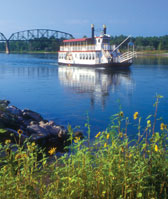
For the greatest view of golden cottonwoods and sandbars-cum-horseshoe courts, opt for a spin on the Lewis & Clark Riverboat. The Governor’s “Tourist Attraction of the Year” for 2006 travels a scenic stretch of the upper Missouri past wild deer, turkeys and sometimes a beaver. Even the park containing the riverboat’s launch site holds some history: a 55-foot, full-scale keelboat that your kids will enjoy exploring. The wooden, masted vessel resembles the one Lewis and Clark used to sail the Missouri.

Take advantage of these attractions and others when the temperate autumn air beckons you for long days outside.

For locals and visitors alike, finding outdoor pursuits during this season comes easily. Boaters and anglers hit the Missouri, while runners, walkers and cyclists appreciate Bismarck’s extensive trail system. Many trails parallel the river, while others wind through town.

“We host the Bismarck marathon and half-marathon in September,” says outdoor enthusiast Melanie Carvell, “and it’s a beautiful course—flat and fast, along the Missouri River bottom just when the leaves are changing color.”

Conclude your afternoon outings with the sun’s evening dip. Meriwether’s Landing, a restaurant situated just steps from the Lewis & Clark Riverboat’s dock, offers the perfect deck from which to see autumn’s long, lazy sunsets. At the Pier at Southport Marina, another choice popular among locals, two-tiered outdoor decks rise above the boulder-lined banks, offering your family a crow’s-nest view of passing boats.

Continue a Bismarck tradition, and take the family to Papa’s Pumpkin Patch. The farm grows more than 30,000 pumpkins, gourds and decorative corn on its 20-acre plot. But the fun isn’t all about produce. Take a hayride or tractor ride for a buck—or a pony ride for $2. The corn mazes alone will keep your family entertained (if not lost) for hours.

Leaf peepers and animal lovers alike will appreciate the Dakota Zoo, on the south side of town in Sertoma Park. The zoo houses the state’s largest collection of animals, with more than 600 birds, reptiles and mammals. Walk the Wilderness Trail to observe native North American species, such as bison, pronghorn antelope, elk, bighorn sheep, moose, and white-tailed and mule deer in environments like those found in North Dakota and across the Rocky Mountain West. At the zoo’s opposite end, visit mountain lions, bobcats, lynx and Alaskan brown bears. Open-air fencing confining these animals might tempt you to step behind the rustic, waist-high barrier to touch these predators as they press against their wire enclosures, but their roars, grunts and snarls remind you that, although captive, these animals remain wild. Rest your legs and still see the animals during a ride on the little green train.

Bismarck’s relaxed, urban atmosphere provides a perfect backdrop for two major fall festivals. Folkfest (September 9–17) celebrates Dakota heritage as more than 150 craftspeople line the downtown streets with their wares, and a street party commences. Longtime resident Jon Mielke calls the event, “Americana at its finest.”

In recent years, the former Folkfest parade merged with the United Tribes International Powwow parade (September 7–10) in a single, colorful Parade of Champions that recognizes the melding of two cultures. “The result is a steady stream of native dancers, marching bands, horseback riders, antique cars and spirited floats,” says Mielke. The September 9 parade runs from the state’s picturesque Capitol grounds through downtown and ends at the popular Kirkwood Mall.

Summer may be giving way to fall, but in the state’s capital, visitors and locals refuse to relinquish their full days outside.


FALL RIDE


Drive south from Bismarck to Fort Abraham Lincoln State Park for a horseback ride through North Dakota’s autumn kaleidoscope. High on the grassy bluffs of the Missouri River where General George Custer and his men set up camp in 1875, your view is as wide as your imagination. Pass historic wooden barracks as you survey the rolling hills and meandering river below. The price is right, too, at just $12 an hour. 701-391-1883. —G.P.

Being Prepared: A Motto to Live by

BEING A PARENT is a huge responsibility. Kids count on us for things we can’t even imagine, until they come up. Montclair soccer coach Bill Gavce had one of those life-changing moments recently on a trip to a small Sierra lake called Middle Loch Leven.

“We’d been going there for 22 years,” he recounted, “the same group of family and friends.”

This year Gavce let his son take a buddy — an 11 year old teammate on his soccer team.

“We hiked in about five miles and were at this small, beautiful alpine lake and the kids were out doing things,” he recalled. What occurred next could have happened to any parent.

“The boys wanted to swim to the three little islands in the lake,” he said, “and one of the boys’ fathers and I were watching from shore.”

The first island was in fairly shallow water. But as the boys swam to the second island, his son’s friend began flailing.

“At first, I thought he was kidding,” said Gavce, but one of the fathers thought it was serious and he started to get in the water. Gavce called for his friend Gary Downs, a strong swimmer who often does triathlons. He was out there like lightning, but the boy had disappeared.

“He’d swallowed some water and was struggling and had passed out and sunk in maybe 15 to 20 feet of water,” Gavce said. When Downs, also a scuba diver, pulled him up — he looked dead.

“He was white as a ghost with blue lips,” said Gavce, who said they did rescue breaths and chest compressions, frantically, one after the other until the boy came around. A 911 call brought a life flight helicopter to the scene within minutes and the youth was airlifted to a nearby hospital.

“He’s fine,” Gavce said, relieved they were able to save the young man who he called a great athlete and normally a good swimmer.

“If there’s anything we can say from all this, it’s for parents to learn CPR,” he said. You never know when you’ll be called on to save a life. Not knowing what to do or how to react — isn’t an option.

SLOW SIGNS: You see them all over the neighborhoods — signs that remind drivers to slow down for kids returning to school. Sue Piper with Vice Mayor Jean Quan’s office said local residents are reusing the placards from last year’s National Walk Your Child to School Day, hoping motorists will slow to 25 mph.

“Unfortunately,” she said, “they were a bit over zealous and placed them on PG&E poles — great for visibility but not legal.”

She’s asking folks to be careful where they put the signs, and also asking PG&E to return the ones they’ve confiscated to her office so they can be reused. They cost taxpayers more than $5 apiece.

MAIL BAG: Thanks to an anonymous caller for tips on how to order a cab for short trips between Montclair and the village. She says most cab drivers will give out their personal cell number and you can call them directly when you need a ride.

Readers have been complaining that cab service is often unreliable in the hills, especially when ordered through a dispatcher. If only we had decent bus service, we wouldn’t have to care.

Meanwhile, reader John Castaldi sees that Oakland has made the New York Times again.

The article on new police efforts to fight crime says that “authorities in Oakland, Calif., have decided to call in the bad guys and tell them to knock it off. Or else.”

Weeks earlier the newspaper ran a picture of a young Oakland man, Amitai Cohen, shown hugging a fellow Israeli soldier after returning from fighting in Lebanon. I wrote about Cohen many months ago when he voluntarily left his home in the hills to join the Israeli army. The photo perfectly captured th

Silver Lining to New Flight Regulations

THERE’S A SILVER LINING to everything in life. Take air travel. I’ve flown twice since the FAA banned liquids on planes. The security lines have been shorter than ever. With everybody checking their bags now, you can breeze to the gate in record time without tripping over a zillion and one rolling suitcases. And once on the plane, you can almost take a nap in the overhead bin — it’s that empty. Now if they’d just give out toiletries with those little packs of peanuts — flying could actually be civilized again.

HAPPY TRAILS: Matt Tinonga is leaving Montclair for the toasty Central Valley. After 14 years as the owner of Montclair Village Wines, he’s selling his business to move to Clovis.

“It’s been a great ride,” he says, “but it’s time to start a new chapter in my life.”

Tinonga and his wife are leaving his childhood home of Oakland to be closer to their grandchildren.

“The decision was agonizing,” he admitted, but after losing his sister last year, he wanted to spend more time with his family. Tinonga says he’ll miss Montclair — especially the friends and customers he grew to love over the years. Good luck, Matt. It’s time to enjoy the fruits of your labor.

CRIME BEAT: Criminal activity is on the rise in Montclair. Even the highest streets in the hills, which typically see fewer thefts and assaults, are being hit. Police say a car was stolen from Manzanita Drive this past weekend, and abandoned at the Montclair Safeway. Minutes earlier, thieves had broken into another car on the street, but took off when they triggered the alarm. Officers say the best way to protect your vehicle is to buy an alarm system, and — when possible — keep your vehicle in the garage when not in use.

BIRD MAN: Glenview bird sculptor Wheatley Allen is waiting for a call from the big guy in Sacramento. He’s got a proposal in to Gov. Arnold Schwarzenegger to create a bronze bird as an annual environmental award. Allen’s sculptures are well known in political circles. Presidents Bill Clinton, George Bush senior, Ronald Reagan and Jimmy Carter all commissioned his work when they were in office. But selling Schwarzenegger a bird could be quite a lofty goal. He seems more like a wild boar or water buffalo guy to me.

TASTY TIDBITS: The old Cesare’s Restaurant in Woodminster is getting a new lease on life. In fact, a Montclair couple has bought the venerable dinner house and is turning it into a Spanish/Italian eatery called Del Navio. Tedro Navio is from Spain and his family has been in the restaurant business since he was knee high. His wife, Marion, is from Italy and has all kinds of family recipes she wants to share.

“We want people to feel comfortable, like they just left my grandmother’s table,” she says. But comfort food isn’t the only thing on the menu. Look for a sports bar, of sorts, with two flat screen TVs and outdoor seating — complete with a dog friendly deck

TAXI TRAUMA: Next time you call a cab, you may want to have a back up plan. Reader Linda Stoneall says she’s had terrible luck trying to get a taxi to take her from her hills house to the village and back. And it hasn’t been just one company that’s left her stranded, but several of the big ones that you see in the Yellow Pages. The last time she was stiffed may have been the last straw. With a cast on her leg, (she’d gone to Montclair for physical therapy) Stoneall was forced to hobble up the trail along Shepherd Canyon Road until someone gave her a ride.

“If I didn’t have friends,” she says, “I don’t know what I’d do.”