The six questions

OAKLAND MAGAZINE: December 2009

Who: Stephen Kent, 51, of Oakland

What: He’s a professional didgeridoo player with his own Music of the World radio show on Berkeley’s public radio station, KPFA-FM, 94.1.

When:
He performs with his trio Baraka Moon throughout the year and has just released a CD by the same name. His radio show airs live on Thursday mornings from 10 a.m.–noon and is archived for two weeks on kpfa.org.

Where: The world is his stage, with performances scheduled across several continents.

Why: As a kid living in Africa, he grew up hearing native instruments, but it wasn’t until 1981 when he became musical director of an Australian circus that he started studying the didgeridoo. “It’s a very primal sound and yet it has a level of sophistication within it that’s quite extraordinary. Part of the reason I play it is people are very attracted to that sound. It roots the listener and some part of ourselves that we’ve lost in our culture.”

How: Kent’s studio is next to his home on a large lot in the Oakland hills. His family supports his endeavors, and his wife is also a musician (vocalist) and recording artist. 

The six Questions

OAKLAND MAGAZINE:  November 2009

Who: Arngunnur Ýr, 46, of Oakland.

Photo by Ginny Prior

What: She’s a guide in her native Iceland, leading hiking tours in French, English and German, then returning to Oakland to capture the raw nature as a professional painter.

When:
The tours take place in summer, when the sun never sets. Winters are spent in her Oakland studio working on dramatic landscape paintings. “They usually have around 100 to 200 layers of [oil] paint when finished, and the sheen of my work has an internal glow which radiates alluring, intense, luminous energy.”

Where:
Tours leave out of the capital, Reykjavik, and highlight Iceland’s rare geological formations like glaciers, geysers and volcanoes. “I love explaining Iceland’s geological history. I know the dates of all the major eruptions, lengths of rivers, depths of lakes and ice sheets, heights of mountains, etc.”

Why: Even after 25 years of living in the United States, Iceland’s
raw landscape and intense weather are part of her character. “There
is something about the elements in the nature … so powerful … they
have such an impact on me.”

How:
Her husband and two teenagers often spend summers in Iceland to facilitate her job and her passion. Her paintings are sold to collectors and featured in major museums. She will be exhibiting at Hosfelt Gallery in San Francisco for three weeks starting Dec. 12.

Riding KCBS Posse

ALAMEDA MAGAZINE MAY/JUNE 2009

In the shadowy hours before dawn, when most of us are logging our last BungerBitker23REMs, two intrepid Alamedans are rolling down the highway, engaged in a lively debate about the day’s unfolding events. It’s a commute fueled by coffee and chatter that only two veteran broadcasters can generate.
KCBS-AM, 740, and KCBS-FM, 106.9, morning anchors Stan Bunger and Steve Bitker have been sharing a ride to their San Francisco studio for almost two years. Talk about a friendship of convenience—they even live near each other on Harbor Bay. Continue reading

A Sports Leader

OAKLAND MAGAZINE MAY/JUNE 2009

For a guy they called “motormouth” in middle school, Brian Murphy seems HR_bryan_3005ideally suited for his job. He’s the morning co-host at KNBR-AM, 680.
But even a sports fanatic like Murphy never thought he’d end up on San Francisco’s leading sports radio station. In fact, when he got the call to do fill-in (Murphy was working the golf beat at the San Francisco Chronicle at the time), he told management he had no idea how to do radio. Continue reading

Hyperkinetic Preservationist: Phil Tagami

OAKLAND MAGAZINE MAY/JUNE 2009

George Bernard Shaw once wrote about the virtues of being “thoroughly Phil Tagamiworn out before you are thrown on the scrap heap.” Phil Tagami, the developer of the Fox Theater and the Rotunda Building, not only posts these words on his Web site, he lives them. In an animated interview in which we never sat down, Tagami wasted no time revealing what drives him.

What is your favorite piece of the Fox Theater renovation?

All the things that still aren’t done. Until it’s completed, until the endowment is fully raised—until everything on our checklist is handled and the building is really dialed in and we really have a good understanding of how to best provide an event space that meets  today’s standards, respects the preservation of the historic fabric and is also economically sustainable so the city doesn’t have to have any fear of supporting it, the job’s not done. Continue reading

An Artist Follows His Dream

Behind the Scenes with Zonk’s Creator

OAKLAND MAGAZINE – MAY 2008

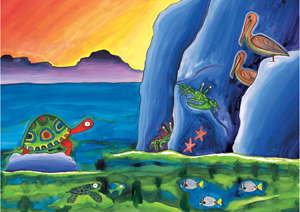
hoobler-photo1Man is nothing if not a dreamer. And “Zonk” is nothing if not a dreaming tortoise. The popular children’s book Zonk the Dreaming Tortoise is the creation of Oakland artist David Hoobler, who seems rather like a turtle himself, at times.
Somewhat shy, with a slightly tentative smile and an unpretentious nature, Hoobler shares a studio apartment with his cat and his colorful imagination. His drawing boards are the focal point of his living room, framing an old steam heater that Hoobler admits makes the room too hot.
Hot like the Sonoran Desert—a region with two rainy seasons that provides the inspiration for Hoobler’s character, Zonk. “In 1996 I was living in Arizona and taking a writing course,” he recalls, “and was given five minutes to come up with a story about a funny little character with a funny name.” Putting pen to paper, he created a desert tortoise who liked water so much that he longed to be a sea turtle. A classmate looked at the piece and said, “That would make a great kid’s book.”
Hoobler launched into action, dusting off his set of barely used, dried-up watercolors (every aspiring painter has one). “They were so solid in the tube, I had to cut them out and put them in a dish,” he laughs. With an art degree from Sonoma State University and a talent he says was passed down from the women in his family, Hoobler created his first image of Zonk the Dreaming Tortoise.
Two books and dozens of paintings later, Hoobler is one of the few artists who actually makes a living off his trade. It takes as much marketing savvy as creativity, something which many artists find difficult. And forget sitting back while the big book stores sell your stuff. “It’s not a system for small publishers,” says Hoobler, who calls chains like Barnes & Noble and Borders too much work. “They want two or three books, and a lot of times they want to keep them on consignment, and then you have to track them down.”
As an author and artist, Hoobler prefers to sell his own products on Amazon and through his own Web site, www.zonktheturtle.com. His online store sells not only paintings and books, but also colorful T-shirts and turtle pajamas. He also works the circuit of art fairs and festivals and even school assemblies.
As the years go by and the artist’s life becomes more entwined with that of his characters, friends have noticed some changes in Hoobler. One day, someone even mentioned how much he’d become like Zonk the Dreaming Tortoise. Or had Zonk become more like him? Either way, they were sharing some similar traits.

“Zonk reflects a lot of my own personality,” Hoobler admits. “I’m very much a fantasizer, and I have a hero complex. I want to do things that are impossible.” At the same time, Hoobler gets really embarrassed when friends make fun of him, not unlike Zonk, who hides when he’s feeling humiliated. If it sounds familiar, it may be because this scenario has played out before—in the life of cartoonist Charles Schulz and his sad-sack character, Charlie Brown.
If only Hoobler’s tortoise and sea characters would catch on like the Peanuts gang. Hoobler holds out hope as he works on his book distribution in Baja, a promising market and a place often mentioned in Zonk’s travels. In fact, it’s here on the Baja peninsula that Zonk and his friends are frolicking in the secret lagoon when they encounter resistance from “locals.” With the aid of some bats and a friendly thermal vent, they flee the lagoon on the back of a manta ray. It’s the final adventure in Zonk’s first trilogy, and Hoobler hopes to have it done by this summer. “I go to Baja to draw, paint and get inspiration for my book, and then I come home and write.” Once the story and illustrations are finished, he has the books printed in Singapore.
“It’s 1 percent inspiration and 99 percent perspiration,” says Hoobler, quoting Thomas Edison as he opens the window to cool down a building that once served as a traveler’s inn in Oakland. The place is temperamental but has character. Hoobler feels it fits him.
Living life simply, but with richness and adventure, Hoobler is grateful. “I’m almost making a living with my art,” he says, “which is quite an accomplishment. I’m not quite the starving artist.”

Dorothy Dugger: BART General Manager

OAKLAND MAGAZINE MARCH 2008

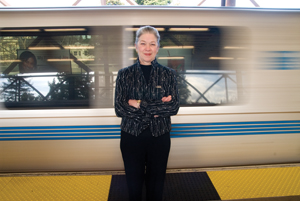
She runs one of the biggest transit systems in the nation. Yet, Dorothy Dugger HR_BART_061is as modest as a southern breeze when it comes to her role as top dog at BART. The girl who grew up on a chicken farm in Alabama sees her job more as a calling—a culmination of life experiences.

How did an Alabama farm girl end up in Oakland?
Well, it’s been a long time since I’ve been at home on a farm. I’ve spent most of my adult life in an urban setting. I moved here from Manhattan, which is as dense an environment as exists in this country. So while I love the outdoors, and I love to get my hands in the dirt and do a little gardening, I’m really at home in the city. Continue reading

At Home on the Docks

howardOAKLAND MAGAZINE – MARCH 2008

Ninety-four-year-old Howard Smith is the baby of the family. At 97, his older sister has three years on him and still lives alone in San Francisco. “She’s a widow and I’m a widower, and we still have our own homes,” says Smith, who has lived in Oakland since 1949.
But good genes (his mother died at 98) are only part of Smith’s secret to longevity. He works several days a month as a docent on the USS Potomac, President Franklin Delano Roosevelt’s “Floating White House” docked at Oakland’s Jack London waterfront. “I love to talk to the guests who visit the ship,” says Smith, who served in the Coast Guard during World War II. “Of course, I didn’t serve on a ship as nice as the Potomac,” he laughs, as he lovingly runs his hands down the shiny brass rails of the presidential yacht.
When Smith isn’t giving tours, his still-agile fingers are tying and “whipping” fancy lines for the ship—a skill that must also be “in the genes.” “I’m pretty good with my hands,” admits Smith, who says his mother was a seamstress and used to let him use her pedal-operated sewing machine. Over a century old, the iron workhorse still operates today.
But you might say Smith is a workhorse himself; when he’s not at the waterfront, he’s restoring broken chairs and making birdhouses and feeders. He’s a bit of a Doctor Doolittle, too. “I’ve had scrub jays come in, and I’ve worked with them and finally gotten them to the point where they were eating off my lap,” he chuckles. His names for two of the blue-crested characters are Gus and Asparagus.
Speaking of vegetables, you can add gardening to the list of Smith’s talents. The sunny spot off his deck boasts rows of peas, carrots, basil and other favorites.
One of Oakland’s most active seniors (he still has his license and drives around town), Smith has a zest for life that can be summed up in a single phrase. “When I get attached to something,” he says with a wink, “I stick with it.”

Michael Pollan: Omnivore

OAKLAND MAGAZINE Feb. 2008

Michael Pollan is a food writer who doesn’t mince words. As a journalism professor at UC Berkeley and author of five books on food production, including the best sellers The Botany of Desire: A Plant’s-Eye View of the World and The Omnivore’s Dilemma: A Natural History of Four Meals, the Berkeley resident offers food for thought on agriculture in America.
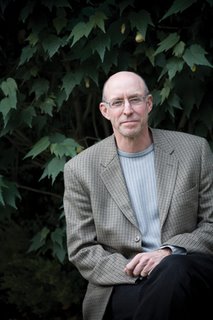
Michael Pollan

Michael Pollan

If I knew what you know about America’s food sources, would I be too grossed out to eat?
Some people have read my accounts of these journeys along the food chain and they’ve become vegetarians. It didn’t have that effect on me, but it changed the way I eat. I really can’t eat fast-food hamburgers, and you know what I really can’t stand? Your basic cheap eggs.

Because they come from unhappy chickens?
They come from battery cage operations. The way they raise [chickens for] eggs is really brutal and kind of disgusting.

What got you started writing about the beef industry?
Harris Ranch on Interstate 5: I’ve passed that place and thought, “My God, this is how we raise beef in this country?” I don’t know how you could drive through that—that stench and that scene and say, “Boy, I really feel like a steak right now.” But lots of people do. It’s apparently a very successful restaurant.

But you still enjoy a good cut of meat every now and then?
I’m happy to eat grass-finished beef and pasture chickens. Berkeley Bowl has Panorama grass-fed beef, Estancia (from Uruguay), and then there’s the local Marin Sun Farms, which you’ll see on menus and [their meats, poultry and eggs are] available at the Ferry Building farmers market. We’re very lucky that there are very good alternatives in the Bay Area.

What about pork?
Niman Ranch pork is a very sustainable product. I’ve been to the farms in Iowa where that’s grown. They live outside, they farrow; they have their babies outside in these little huts instead of these brutal cages that are just a little bigger than their own bodies.

What struck you most in your travels across America?
The landscape in Iowa in April was very striking. It’s black. There’s nothing green there because all of it is corn and soybeans. And they don’t get planted till late spring, so before that it’s just naked soil. There are no horses anymore, no meadows, no chickens, no orchards—corn has just taken over this landscape. It’s a monoculture, and monocultures are striking landscapes, for as far as you can see—the same thing. It’s very dreary.

You’re a wordsmith, and your wife, Judith Belzer, is a noted nature painter. You must be drawn to one another, pardon the pun.
There’s a lot of cross-fertilization that goes on in our work. A normal workday is, I’m writing upstairs, she’s painting downstairs, and we meet for lunch and grunt at one another because we’re too absorbed in what we’re doing. But there always comes a time when she reads what I’m writing and I look at her paintings.


Burning Down the House

OAKLAND MAGAZINE – NOVEMBER 20007

la-tazaWhen Daniel Brajkovich opened La Taza de Café in Montclair in 2004 , I knew we couldn’t keep him. His savory tapas and hot Latin Jazz were too big to contain in a small neighborhood restaurant. He needed a whole house.
Today, he’s bringing the house down with a Cuban café and club that’s so popular it’s often packed to the rafters. Of course, there’s the ever-changing weekly menu, from small plates with various combinations of grilled chops, plantains and spicy sauces to such platos grandes as garlic-studded slow-roasted pork and snapper almandine. Then there’s the dancing. Take a Saturday night this past summer, for example, when a room full of patrons paid $8 each to learn how to salsa. The instructors were the sexy dance duo of Garry Johnson (longtime dance teacher at Allegro Ballroom in Emeryville) and his partner, Viola Gonzales. As the lesson progressed, the warm yellow house at 3909 Grand Ave. (formerly the site of Autumn Moon restaurant) started to come alive. Women in sleek, sexy outfits and guys in cool cotton cabana shirts were pouring into the bar, the back room, the outside patio and two rooms upstairs.
The champagne mojitos started to flow and bodies pressed seductively against one another as the primal beat pumped through the halls. I could sense that something was about to explode—like spontaneous combustion from too much heat. And then it began; couples twirling in tandem to the intoxicating rhythm, as if they were dancing under a star-studded Havana sky.
It’s human nature to want what you cannot have. Cuba is off limits to most Americans, yet we have an insatiable urge to taste—to experience—if only for one passion-filled night. La Taza de Café answers the call.
La Taza de Café, 3909 Grand Ave., (510) 658-2373, is open Tue.–Sun. for tapas, dinner and dancing, and serves brunch 10 p.m.–2 p.m. Sun. For a schedule of dance lessons and entertainment see www.latazadecafe.com.