TRANSPORTATION – GOING ELECTRIC

ALAMEDA MAGAZINE

July/Aug 2007

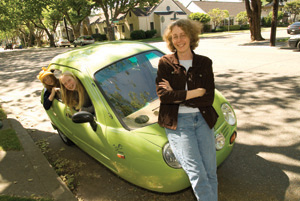
zapcarMargaret Starbuck can’t go anywhere without getting a laugh, or a stare or aook of befuddlement. She’s
one of a growing number of motorists who drive electric cars in Alameda. Starbuck bought the four-seater ZAP Zebra from O’Connell Electric a few months back and loves the attention she gets while cruising in her three-wheeled vehicle, which looks more like a bug than a car.
“Driving down the street, it cracks us up. My 13-year-old daughter and I get these double takes,” she says. Starbuck commutes to Berkeley and back at speeds of up to 40 mph (too slow for the freeway) and has almost no fuel costs. “It’s just 50 cents a charge,” she says. “That’s 3 cents a mile.”
Pulmonologist Steve Lowery is another Alamedan who’s leading the charge to go electric—not just to save bucks at the pump, but to save lives. “We see, on a Spare the Air day, more respiratory illnesses in the emergency room,” he says. Lowery feels so strongly about reducing car emissions that he recently convinced his friend, Mike O’Connell, to sell ZAP cars at his Volvo dealership on Webster Street.
O’Connell didn’t have to be asked twice. Like Lowery, he’s a fan of fresh air. “I decided to do this when I looked down in the engine compartment of the ZAP and didn’t get a face full of smoke. I knew electric cars were the wave of the future.”
And when it comes to making waves, Alameda is the perfect town. “It’s an island and an oasis of people,” says ZAP’s Alex Campbell, who sees Alameda as a place with extremely community-conscious residents. And the terrain doesn’t hurt, either. “It’s flat, and electric vehicles have a hard time with hills,” he admits, “but in Alameda, especially with the range of electric cars—it’s perfect.” At 40 miles to a charge, you can go anywhere in town and back. Plus, these cars plug into any 110 outlet. Please contact Ginny Prior for a reprint of the entire article)

SEGWAY POLO – GOING GEEK

OAKLAND MAGAZINE
July/Aug ’07

segwayWho says you can’t teach an old dog new tricks? Just look at the Oakland Junkyard Dogs, a scrappy team that plays polo on Segways. Instead of horses, these guys ride personal mobility assistance devices, those futuristic machines usually seen traveling in pods at popular tourist sites.Think expensive stand-up scooters (priced up to $5,000)—without the gas. These vehicles run on an electric motor with gyroscopes and computer boards. You lean forward to go forward, and back to go backwards. They turn on a dime at a top speed of about 13 mph. It’s a phenomenon of man and metal melded into a lean, mean fighting machine.

“It’s the first of the future death sports,” laughs Steve Steinberg, co-owner of Segway of Oakland. Played like polo in four eight-minute segments called chukkers, the game is won by the team with the most goals at the end. But getting those goals isn’t so easy, as I can attest. On a recent Sunday, I was asked to fill in for a no-show on the opposing team, the Silicon Valley Aftershocks. With mallets and metal flying across the field, it was all I could do to stay upright and out of the way.

“The game can get pretty heated,” says Drew Foster, one of the younger Dogs players. “You can battle on these things.” And indeed he has battled—with one of the richest men on Earth, Apple Computer co-founder Steve Wozniak. “A lot of people go after him, ’cause, hey, it’s your chance to whoop up on a billionaire,” laughs Foster. But, he says, Woz is no wimp. In one exhibition game a Junkyard Dog ran into the Apple icon’s Segway and Woz went flying. “He broke a fender and cut his hand open,” says Foster, “and he kept playing. He bled over everyone’s machines.”

There’s no doubt Wozniak is one of the driving forces behind the game. His Silicon Valley team, the Aftershocks, is hosting this year’s Woz Challenge Cup, slated for July 20–22 in the Bay Area. Last year’s inaugural tournament was held in New Zealand, and teams from around the world came to play. Even China has a team, started by action star Jackie Chan.

Oakland has its own celebrity in Victor Miller. In his mid-60s and the oldest player on the Dogs, Miller wrote the screenplay (or should I say SCREAM play) for Friday the 13th. When he played goalie, his team wanted to buy him a hockey mask like the one his character, Jason, wore during his killing spree. Not surprisingly, Miller switched positions.

One thing these guys have in common is their fun-loving spirit—and total absence of ego. They’re grown men playing polo on funny-looking machines and they know it. “It’s geek city,” says Miller, “but you’ve got to love it.”

GOING NORDIC


Jan/Feb 2007

Trading Alpine for Cross-Country Skiing

By Ginny Prior

There comes a time in everyone’s life when serenity trumps the party scene. When following the crowd is no longer cool. When, as Huey Lewis put it, “It’s hip to be square.”
As a skier, I figured this out a few years back, at Sugar Bowl. Carving my way down a popular run, a whistle stopped me dead in my tracks. Two hotshot patrollers were marking an obstacle. “We’re the fashion police,” one of them yelled. “You’re under arrest!” I blushed as it dawned on me that my hot pink ski pants might no longer be in vogue.
As I took time for lunch later that day, I saw women in their faux fur jackets with their Burning Love skis and matching pink boots. I saw teens with their designer grunge pants and Burton boards that cost more than my first car. I saw me in the mirror with gear from (gasp) the last millennium.
It was then that I had an epiphany. To continue my love affair with winter, I would have to tweak the experience—forgo the downhill speeds and the uphill lifts in favor of a sport that, until now, seemed too tame for a seasoned skier like me. I would have to go Nordic.
The Bay Area is blessed with some great Nordic skiing less than three hours away. One of my favorites is Royal Gorge, the largest cross-country ski area in North America. Off Interstate 80 at the Norden exit, Royal Gorge has a big network of trails on more than 9,000 acres. Some days you can ski on groomed tracks for hours without seeing another two-legged being.
Nordic skis are much thinner and lighter than downhill skis, and you’ll need a lesson if you’ve never tried them. Of course, rentals and lessons are available at most cross-country ski areas. You’ll notice, almost immediately, the laid-back feel of these resorts. No long lines for rentals. No tangle of poles and boots as you try to try desperately to get outfitted by lunchtime. A Nordic boot fits like a slipper. They’re so snug and comfy, some folks wear them all day—even on the drive home. And a snug, comfy fit means more time on skis, burning calories and getting toned.
There are several ways to ski at cross-country resorts. Some like to skate ski, with a motion that resembles speed skating and a workout that tones your buttocks…

To read the complete article, contact Ginny Prior

Luring in Luxury

AAA LIVING MAGAZINE

MINNESOTA Jan/Feb 2007

A combination of hardy Midwestern mentality, a lake lover’s favorite food and jovial tall tales, ice fishing may be the quintessential Minnesota sport. Lately, it’s even gotten more comfortable.

On the surface, the idea sounds as though your brain may be experiencing a cold snap—fishing on ice in the dead of winter. But, then a 10-pound walleye tugs at your line, and things get hot in a hurry. Wait, is the sudden heat due to the rush of blood and adrenaline since you’ve snagged a big one, or did someone turn up the thermostat?

That’s right, ice fishing has evolved from the days when folks sat on stools with wool mufflers wrapped around their necks and transistor radios by their sides. Today’s anglers can sit back in only a T-shirt, watch TV, even sleep in a real bed.

“Ice fishing has come so far so fast. It’s unbelievable the technology that’s used today,” says Brainerd Lakes fishing guide Dan Eigen, better known as “Walleye Dan.” He has guided for 18 years in this fertile fishing region, where anglers catch limits of walleye, perch, northern, crappie and blue gill. When clients want the best fish house money can buy, he rents out his “tricked-out” SnoBear, a high-tech, motorized ice-fishing house.

“It goes 18 mph on two tracks and skis,” Eigen says, “and it’s got the same electronics that I’ve got in my boat.” Just pull it up to your favorite hole, and the house hydraulically lowers down to the ice with six holes for fishing. Add to that the thermostatically controlled propane furnace, stereo/CD player, built-in underwater camera and other fish-finding electronics, and you’ve got the latest in fish house technology.

If you want to spend the night, Eigen even rents sleeper houses with four beds, a furnace and rattle reels that “ding, ding, ding” to awaken you when you’ve caught a fish. “We’ll even bring out a TV and hook it up to the generator for you,” he says. “All you need is your fishing license and food.”

Such luxury is a far cry from the days when Brainerd Lakes resident Don Neumann fished out of his old Model A. “We used to buy these old cars and cut holes in the floor boards,” he remembers. When Neumann met his wife, Joyce, she put her foot down. “I told him it was too cold to fish outside, and I went and bought a wood-paneled ice-fishing house with a heater and curtains on the window.” Suddenly fishing was a lot more fun. They’d have couples over for cribbage and cocktails as their bobbers popped merrily in the holes near their feet.

Ice fishing means different things to different people. Not everyone wants an encampment, where flannel-clad villagers share steaming pots of chili and elect “seasonal” mayors. Eigen, for one, considers fishing a solitary sport in which you park your fish house on your secret spot and cast a mad glare toward any fisherman who pulls up next to you. If that’s your thing, then the thought of sharing the ice with 11,000 other anglers may not seem appealing. But for more than $100,000, maybe you’d sacrifice your bit of fishing heaven.

For 16 years, the Brainerd Lakes Jaycees have awarded the world’s largest cash prizes at their $150,000 Ice Fishing Extravaganza (scheduled this year for Jan. 20). A cannon signals the start of competition, which usually is held on massive Gull Lake. For three hours, anglers from all over the world drop their lines in the icy waters of their own, pre-drilled holes. Men, women and children all compete in this open-air event, where fish houses are banned and only live fish may be weighed and measured.

It’s a scene out of Grumpy Old Men, with folks wearing everything from screaming orange hunting jackets to fur-lined hats with animal tails. And that’s just the women.

The Ice Fishing Extravaganza crowds Gull Lake for only one day, but on 18-mile-wide Mille Lacs Lake, whole villages spring up for the entire season. “There are probably as many as 10,000 houses out there. People pull the 10-by-26-foot houses onto the lake, and they’ve got microwaves, TV’s, refrigerators—even beds,” says Eigen. With those amenities, some folks spend all winter in their ice-fishing house.

Of course, owning an ice-fishing house is not everyone’s idea of a second home. If you’d rather rent, there are dozens of resorts that will set you up in Brainerd Lakes. Cragun’s and Grand View Lodge, two of the bigger resorts in the area, each spread across acres of shorefront on Gull Lake. At Cragun’s, you can rent a four-hole house for $30 for four hours. Minnows cost $2–$4 a scoop. Grand View Lodge uses Eigen as the resort’s outfitter/guide, and he provides the ice-fishing gear, including his upscale digs, and guidance.

Wherever you go, you’ll find anglers have one thing in common: They dream of catching that legendary fish that every Minnesota lake seems to contain. In the Brainerd Lakes region, a 15-pound walleye caught in 1983 holds the record. Eigen, himself, caught a 13 pounder in 1992. But apparently, there are even bigger fish to fry—so to speak.

“In Gull Lake, there’s a fish we call Jingles that’s got so many hooks and spinners hanging off of her that when she swims by you can hear the ‘ting,’ ‘ting,’ ‘ting.’” And what would Eigen do if he caught Jingles? “I’d probably take off a few of her accessories and then put her back—and retire,” he laughs. Sounds like a fitting end to a Minnesota fish tale.

To read the complete article, contact Ginny Prior
NASHVILLE – MUSIC CITY AND MORE

January 5, 2007

By Ginny Prior

NO MAN is as sexy as a man in a cowboy hat. I’ve had this conviction since my college days at Montana State University. But when it comes to studs in Stetsons, Montana’s got nothing on Nashville — where cowboys are crooners in a city that celebrates country music.

They don’t call Nashville “Music City” for nothing. Music is to Nashville what movies are to Hollywood. There are over 180 recording studios in Nashville, as well as the Country Music Hall of Fame, the Grand Ole Opry and literally hundreds of places showcasing live talent. It seems almost everyone in Nashville is either a musician or a song writer — holding out hope they’ll hit pay dirt.

Dolly Parton got her big break in Nashville, saying she was so poor when she left home she had nothing to lose. It wasn’t long before she was singing with Porter Wagoner on the Grand Ole Opry.

A kid named Elvis made his name here. He recorded some monster hits in RCA’s famed Studio B. Songs like “Are You Lonesome Tonight?” and “Little Sister” were smash records for “The King” and you can almost picture those late night recording sessions when you tour Studio B today. The studio closed permanently for commercial recordings the day after Elvis died in 1977, but not before producing a thousand hits for legends such as Roy Orbison, Eddie Arnold and Patsy Cline.

The Country Music Hall of Fame brings these artists and their music to life. One of the most innovative museums in the country, it takes you on a journey through time, from the early years of folk to the sounds of hillbilly, honky tonk and the more sophisticated strings and vocals that made up the Nashville Sound of the 1960s. The Hall of Fame houses a priceless collection of clips from radio, television and film that tells the story of America’s love affair with country.

It’s as much a timeline of our nation as it is a tribute to its music.

It’s billed as “everyman’s music.” A bottle of booze, a broken heart, an old yellow dog and a pickup truck. The key to writing a good country song is to tell a simple story — one folks can relate to. And while it wouldn’t be on every visitor’s list of attractions, you can pay a local writer to help you come up with your own country song. It’s more than just writing a couple of verses and a chorus. You need a catchy melody and a good hook.

The Bluebird Café is a favorite venue for songwriters. The night I was there, four of Nashville’s best were taking turns playing some of country music’s biggest hits. These guys, virtually unknown outside the industry, were singing the pieces they wrote that made millions for stars like Kenny Chesney and Travis Tritt. They sat in a circle and swapped stories and songs in a space that seemed more like my living room than a legendary nightclub. And their poetry touched raw emotions as they sang about relationships, motherhood, patriotism and faith.

I think I paid 15 bucks to see them that night — about a penny a tear.

It’s even cheaper to hear music in Nashville’s famed honky tonks. Sure as a dog is man’s best friend, these blue-collar bars have the music cranking, day and night. Walk into Roberts or Legends or Tootsie’s Orchid Lounge and grab a stool. What you’ll hear is some of the best live country this side of the Smokies — with no cover charge, just a pass of the cowboy hat.

But the “Mother Church of Country Music” is still The Ryman Theatre, home of the Grand Ole Opry each winter. The Ryman actually started out as a church, and the stained glass windows and warn wooden pews are still part of its charm. Even more heavenly are the acoustics, which make the live broadcasts sparkle. It’s a real treat to watch WSM radio broadcast the Opry live each weekend with some of the biggest names in country music gracing that historic stage. And just like the early days of the Opry, you never know who will pop in.

One thing is certain — Nashville has style. From its imaginative downtown skyline to its stately southern plantations, the city makes a statement. You can tour dozens of historic sites, including the beautifully restored home of President Andrew Jackson. Take a picnic and enjoy the lush grounds of Vanderbilt University, a national arboretum with tree-lined paths and rolling green lawns. Or take in one of Nashville’s most surprising sites — the world’s only full-sized reproduction of the Greek Parthenon, complete with four art galleries and a giant gilded statue of the Goddess Athena.

And while Nashville is known for its architecture, there’s something else catching the eye of folks who visit. It’s the sparkle of rhinestones on the outfits of country artists who order their clothing from Manuel. With just one name (think Cher or Prince) Manuel has been the tailor to the stars, here, for decades. He’s the guy who put Johnny Cash in black and Elvis in tight pants and Dolly Parton in her eye-popping blouses. His personality is as big as his creations, yet he still sews by hand in a modest downtown house.

And that’s the attraction of Nashville. It’s one of the most fascinating and cosmopolitan cities in America, yet it’s warm and inviting — and approachable. Like a man in a cowboy hat — it exudes charm.

ON FROZEN POND


AAA LIVING IN MICHIGAN, INDIANA & ILLINIOIS January/February 2007

by Ginny Prior

Bone-chilling gusts propel iceboats across frozen Midwest lakes, but the thrill of this winter sport may take you around the world.

An iceboater enjoying the chills and thrills of skimming across a frozen lake. Bone-chilling gusts propel iceboats across frozen Midwest lakes, but the thrill of this winter sport may take you around the world.
On almost any lake with safe ice you’ll see them: ice yachts being piloted across the shimmering surface at breakneck speeds. Well, hopefully not breakneck speeds.
Iceboats can go faster than 90 mph (the world record is 148 mph). With a hull that weighs just 46 pounds, most race boats glide at a respectable 35–55 mph with moderate winds. “When you’re going on a boat that light, you’re literally flying,” says four-time world-champion DN racer Ron Sherry. Come winter, the boats with their colorful sails billowing in the wind, will make their way onto Midwest lakes with thick, black ice that’s relatively free of snow.

To read the rest of this article, contact Ginny Prior.

Restorative Retreat


OAKLAND MAGAZINE/ALAMEDA MAGAZINE – November 2006

In the shadow of Mount Diablo, with an eye-popping view of the San Ramon Valley, sits an extraordinary villa and gardens. It’s sweet irony that this heavenly refuge shares such a dramatic landscape with the “devil mountain.”
Since 1961, people have been making retreats to San Damiano. The colorful gardens and mission-style buildings offer the perfect place for quiet reflection, long healing hikes and surprisingly good meals. Set on 55 acres of tree-studded hills, San Damiano is the antidote to the toxic stress of Bay Area living. Its chapel, fountains and meandering footpaths allow visitors to do something almost unheard of in this day and age—spend deep, restorative time alone.
It took turning 50 for me to completely understand the power of this place. As I drove through the quaint town of Danville past lush green lawns and million dollar homes, I hoped to come to peace with this sudden advancement in age. The gray hair, the wrinkles and the constant barrage of AARP invitations in my mailbox were a powerful catalyst for a mid-life meditation.

To read the full article, contact ginny prior.

Sonoma Wine Country Holds Autumn Charm

MONTCLARION NEWSPAPER

– SEPT. 30, 2006

WHEN YOU THINK of autumn leaves, you probably think of New England — or maybe the Midwest. Their stands of fiery maples and golden birch are so resplendent; they call to a whole class of tourists called Leaf Peepers.

But here on the West Coast, we have our own fall color. It peaks more toward winter and is every bit as beautiful as a deciduous forest. It’s the wine country, where the leaves on the vines blush brilliant shades of burgundy and gold. It’s nature’s great show, and the timing couldn’t be better, as the crush is just ending and the vineyards sleep silently until spring.

The Sonoma wine country is simply gorgeous this time of year. The days near Halloween are a cacophony of color for grape-growing regions like Dry Creek and the Alexander Valley. Head north on Highway 101 to Santa Rosa and stop for a cup of coffee at the historic Railroad Square. Locals and tourists alike come here and you’ll feel the energy as you browse the antique shops and the hip cafes. It’s a great launching point for your fall color tour and tastings.

With Santa Rosa as your starting point, you can choose from three colorful country drives. All are lightly traveled and incredibly romantic this time of year. The northern route takes you through one of my favorite places, Healdsburg. Lovers still stroll hand-in-hand in this charming town, window shopping and exchanging pleasantries with neighbors and merchants on the street. Healdsburg is known for its restaurants, which feature a bounty of meats and produce raised in the region. You’ll find everything from Muscovy duck to goat cheese and Pacific oysters, any of which can be packed for an afternoon picnic. From town, head toward Highway 128 for a delightful drive through the Alexander Valley. There are 28 wineries in this region, and more than 15,000 acres of vineyards blanketing the valley and surrounding hillsides. The wines run the gamut from soft cabernets to rich chardonnays and newcomers like French syrah and Italian sangiovese.

The second route takes you west from Healdsburg through the cooler climates of the Russian River appellation — perfect for pinot noir. There are 50 wineries in this region as you wind your way toward Jenner and the Pacific Ocean. In early November, you’ll still see pumpkins on the vines, along with colorful flower farms and places to cut your own Christmas trees.

If a warmer climate suits you, the third route takes you southeast from Santa Rosa along Highway 12 — through Sonoma’s famous Valley of the Moon. This is where Franciscan Padres planted the county’s first grapes in 1823 and you can still see the ancient winery stone shells today. With charming old towns like Sonoma and Glen Ellen, Highway 12 is a favorite route through a region that produces everything from peppery zinfandel to buttery cheese.

While cars and motorcoaches are the easiest way to tour the Sonoma Wine Country, they may not be the most satisfying. Consider riding a bike along the miles of flat and gently rolling roads that traverse the vineyards.

There’s a sweetness to the air as you ride past fields and farms and stop to taste a grape or two. On a bike you can take your time to stop at the bounty of boutique wineries that dot the country lanes.

If adding a little horsepower to your vehicle sounds better, you can do it, literally, by renting a horse-drawn carriage from Flying Horse Carriage Co. Using elegant coaches and well-behaved draft horses, they take you on a delightful ride through the Alexander Valley, where the sounds of the wagon wheels and the horses hooves almost lull you to sleep.

The owner and coachman, Bret Le Rolland, loves to stop and pick you a grape, then compliment it with a glass of wine and fine cheese. For sunny days he provides parasols — on cooler days, blankets. Along the way, he points out things of interest as the horses climb the hillside for a gorgeous view of the valley below.

There’s another way to see the Sonoma Wine Country, if you have the stomach. Just south of Sonoma is a regional airport where Chris Prevost keeps his planes. Not just any planes, but vintage World War II planes with open cockpits. Just say the word and he’ll show you a view of the wine region that few get to see. Donning a parachute and leather helmet, you climb the ladder to the cockpit where you’re strapped in for a thrill ride of dips and turns that are as mild or as wild as you request. Chris takes you low over long-lashed cows and fields of clover, then up for a wide-angle view of the valley and beyond. It’s one of the best ways to see the Sonoma Wine Country.

So pack a blanket and a thermos of soup, and head north this fall for some of the best autumn colors on Earth. When it comes to seasons — Sonoma can hold its own with the best of them.

If you go there:
Sonoma County Convention and Visitor's Bureau
800-404-7673

California Wine Country Bike Tours
866-922-4537

Flying Horse Carriage Co.
707-849-8989

Vintage Aircraft Co.
707-938-2444

Magical Mount Tam

Alameda Magazine

September/October 2006

Hoofing it to the West Point Inn

west-point-inn-0906I probably shouldn’t be telling you this. But then, travel writers rarely keep secrets. There’s an incredible place to stay in Marin for just $35 a night: Rustic and hidden, the West Point Inn is perched on the side of Mount Tamalpais-and getting there is half the fun.

Cars aren’t allowed at this inn in the woods, unless cleared by the West Point’s custodian, so you earn your stay by hiking a 2-mile trail from the Pantoll ranger station. Peaceful and scenic, the trail ascends gently past waterfalls and brooks, over wooden footbridges and past lush ferns and wildflowers. On your way, take a sandwich from your backpack and sit on a rock as you breathe in the fresh forest air-it’s surprising to think you’re just minutes away from the stress of the big city.

At this moment I realized, it’s not about
the money-it’s about the experience.

Visitors have been coming to the West Point Inn for more than a century. It was built in 1904 as a stopover on the famed Mount Tamalpais Railway line. Dressed in their finery, folks took the train up the winding mountain track to what felt like the top of the world. The West Point Inn was a respite, overlooking San Francisco, Marin and the East Bay. The view is even more stunning today.
On a balmy summer night, I sat with friends on the wraparound deck that tickles the nearby pine trees. We’d spent the day hiking the trails on Mount Tam and had worked up a monstrous appetite. Someone uncorked a bottle of wine, and suddenly cheese and crackers appeared, along with salsa, chips and even a plate of sushi. It’s amazing what you can fit in a backpack! Someone even brought a guitar, and the music echoed softly through the pines as the conversation ebbed and flowed.
Years ago, there was a restaurant here for travelers, but these days you’re on your own with the cooking. The kitchen has two big stoves, refrigerators and an abundance of pots, pans and plates. You bring up the food and drink and, of course, you’re responsible for cleanup, too.
The accommodations are sparse, but well maintained, and (thank goodness) there’s indoor plumbing. There are seven interior rooms with lighting and heat and five outdoor cabins with neither. Needless to say, it’s warmer indoors, although the rooms are smaller. The outdoor cabins work better for families and can accommodate up to eight people. There is also a handicapped-accessible cabin. There are blankets and spreads on the beds, but you need to bring your own linens or sleeping bags. And you’re really not supposed to bring pets-the house cat, which has free rein of the inn, doesn’t appreciate the competition.
The West Point Inn is run mostly by volunteers, so be patient when making reservations. It could take a couple of days for them to get back to you. It’s open Tuesday through Saturday, year-round, and rates are $35 a night for adults and half price for kids under 18. Groups of 20 or less can book the entire inn for $700.
It was after dinner, as we relaxed under the canopy of trees and a brilliantly sequined sky, that it hit me. I could see maybe a million twinkling lights in the valley below, people going about their busy lives, while I had transcended to this heavenly place in the stars. At this moment I realized, it’s not about the money-it’s about the experience.

Getting There

From Oakland, take the Richmond/San Rafael Bridge to southbound U.S. 101 to state Highway 1/Mill Valley/Stinson Beach exit. Follow Shoreline Highway about 1 mile to the junction with Almonte and turn left, driving about 2.5 miles to the junction with Panoramic Highway. Turn right on the Panoramic Highway and continue for about 1 mile to the junction with Muir Woods Road. Go straight on the Panoramic Highway 4.5 miles to the junction with Pantoll Road and turn right onto Pantoll Road. The trailhead is near a small pullout on the right. If it’s full, park at the nearby Pantoll ranger station (415-388-2070; $6) across the Panoramic Highway from the Pantoll/Panoramic junction. For information on the West Point Inn or for reservations, call (415) 646-0702.

Hit the Marck

AAA Living Magazine
September/October 2006

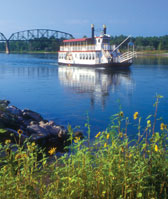
Lewis & Clark Riverboat

Lewis & Clark Riverboat

Fall brings a seasonal magic to Bismarck best enjoyed from the Missouri River.

For the greatest view of golden cottonwoods and sandbars-cum-horseshoe courts, opt for a spin on the Lewis & Clark Riverboat. The Governor’s “Tourist Attraction of the Year” for 2006 travels a scenic stretch of the upper Missouri past wild deer, turkeys and sometimes a beaver. Even the park containing the riverboat’s launch site holds some history: a 55-foot, full-scale keelboat that your kids will enjoy exploring. The wooden, masted vessel resembles the one Lewis and Clark used to sail the Missouri.

Take advantage of these attractions and others when the temperate autumn air beckons you for long days outside.

For locals and visitors alike, finding outdoor pursuits during this season comes easily. Boaters and anglers hit the Missouri, while runners, walkers and cyclists appreciate Bismarck’s extensive trail system. Many trails parallel the river, while others wind through town.

“We host the Bismarck marathon and half-marathon in September,” says outdoor enthusiast Melanie Carvell, “and it’s a beautiful course—flat and fast, along the Missouri River bottom just when the leaves are changing color.”

Conclude your afternoon outings with the sun’s evening dip. Meriwether’s Landing, a restaurant situated just steps from the Lewis & Clark Riverboat’s dock, offers the perfect deck from which to see autumn’s long, lazy sunsets. At the Pier at Southport Marina, another choice popular among locals, two-tiered outdoor decks rise above the boulder-lined banks, offering your family a crow’s-nest view of passing boats.

Continue a Bismarck tradition, and take the family to Papa’s Pumpkin Patch. The farm grows more than 30,000 pumpkins, gourds and decorative corn on its 20-acre plot. But the fun isn’t all about produce. Take a hayride or tractor ride for a buck—or a pony ride for $2. The corn mazes alone will keep your family entertained (if not lost) for hours.

Leaf peepers and animal lovers alike will appreciate the Dakota Zoo, on the south side of town in Sertoma Park. The zoo houses the state’s largest collection of animals, with more than 600 birds, reptiles and mammals. Walk the Wilderness Trail to observe native North American species, such as bison, pronghorn antelope, elk, bighorn sheep, moose, and white-tailed and mule deer in environments like those found in North Dakota and across the Rocky Mountain West. At the zoo’s opposite end, visit mountain lions, bobcats, lynx and Alaskan brown bears. Open-air fencing confining these animals might tempt you to step behind the rustic, waist-high barrier to touch these predators as they press against their wire enclosures, but their roars, grunts and snarls remind you that, although captive, these animals remain wild. Rest your legs and still see the animals during a ride on the little green train.

Bismarck’s relaxed, urban atmosphere provides a perfect backdrop for two major fall festivals. Folkfest (September 9–17) celebrates Dakota heritage as more than 150 craftspeople line the downtown streets with their wares, and a street party commences. Longtime resident Jon Mielke calls the event, “Americana at its finest.”

In recent years, the former Folkfest parade merged with the United Tribes International Powwow parade (September 7–10) in a single, colorful Parade of Champions that recognizes the melding of two cultures. “The result is a steady stream of native dancers, marching bands, horseback riders, antique cars and spirited floats,” says Mielke. The September 9 parade runs from the state’s picturesque Capitol grounds through downtown and ends at the popular Kirkwood Mall.

Summer may be giving way to fall, but in the state’s capital, visitors and locals refuse to relinquish their full days outside.


FALL RIDE


Drive south from Bismarck to Fort Abraham Lincoln State Park for a horseback ride through North Dakota’s autumn kaleidoscope. High on the grassy bluffs of the Missouri River where General George Custer and his men set up camp in 1875, your view is as wide as your imagination. Pass historic wooden barracks as you survey the rolling hills and meandering river below. The price is right, too, at just $12 an hour. 701-391-1883. —G.P.